Emerging Trends in AI Ethics and Governance for 2026


Emerging Trends in AI Ethics and Governance for 2026
AI adoption has progressed rapidly from pilot projects to enterprise-wide deployment. By 2026, the challenge is not building models, but rather proving that they are trustworthy, auditable, and accountable. Regulators, customers, and boards now expect evidence that AI systems are governed with the same rigor as financial or cybersecurity controls.
Traditional policy documents are no longer enough. CIOs, CISOs, and compliance leaders need to embed operational governance directly into AI pipelines. This means model inventories, approval workflows, monitoring dashboards, and incident playbooks. Governance has shifted from being a compliance afterthought to becoming a business enabler.
For technology executives, the urgency comes from two directions:
- External pressure: Global regulations such as the EU AI Act, U.S. state laws, and Asia‑Pacific frameworks demand demonstrable controls.
- Internal risk: Bias, drift, and data leakage can erode trust faster than innovation can scale.
The message is clear. In 2026, governance is the deciding factor between AI that scales responsibly and AI that stalls under scrutiny. This article explores the emerging trends in AI ethics and governance, outlines what leaders should implement within 90 days, and highlights common pitfalls that undermine trust.
The New Playbook: Emerging Trends in AI Governance
By 2026, AI governance will have shifted from being a compliance checkbox to becoming the foundation of enterprise trust. CIOs, CISOs, and compliance leaders are no longer judged on whether they have policy documents in place. Instead, they are measured by how well governance is embedded into daily operations, from model approvals to bias testing and vendor contracts.
This section highlights the key trends shaping AI ethics and governance in 2026. Each trend reflects the growing demand for accountability, transparency, and resilience in AI systems. Together, they form a practical playbook for leaders who need to scale AI responsibly while meeting regulatory and customer expectations.
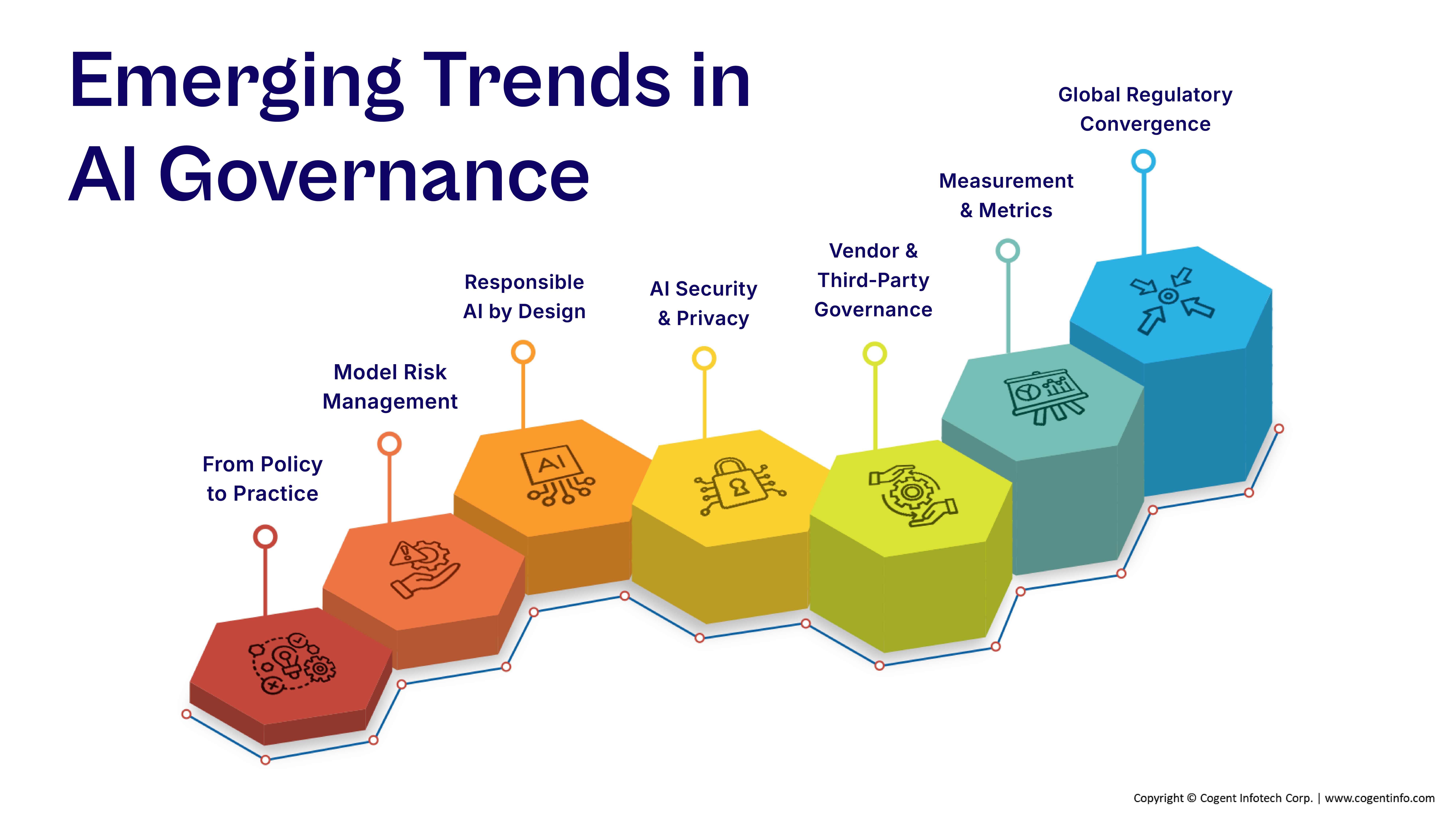
Trend 1: From Policy Documents to Operational Controls
For years, AI governance often meant drafting policy documents that outlined principles of fairness, transparency, and accountability. In 2026, that approach will no longer be enough. Regulators, auditors, and customers now expect organizations to demonstrate how these principles are embedded in day‑to‑day operations.
The shift is clear: governance has moved from paper to practice. Instead of relying on static guidelines, enterprises are building operational controls that monitor and enforce compliance in real-time.
Key elements of this shift include:
- Model inventories: A central registry of all AI models in use, including their purpose, risk rating, and approval status.
- Approval workflows: Formal checkpoints before models go live, ensuring risk reviews and compliance sign‑off.
- Monitoring dashboards: Continuous tracking of model performance, fairness metrics, and drift indicators.
- Incident playbooks: Pre‑defined response plans for bias detection, security breaches, or unexpected outcomes.
For CIOs and compliance leaders, this trend means governance is no longer a separate function. It is integrated into the AI lifecycle, from design to deployment. The organizations that succeed will be those that treat governance as an operational discipline, not a compliance checkbox.
Trend 2: Model Risk Management
By 2026, organizations are expected to treat AI models with the same rigor as financial assets or cybersecurity systems. This means building a clear framework for model risk management that goes beyond technical performance and addresses accountability.
Key practices include:
- Model inventory: Maintain a central record of every AI model in use, including its purpose, risk rating, and ownership.
- Approval workflows: Require formal sign‑off before deployment, ensuring compliance and risk reviews are completed.
- Monitoring and alerts: Track accuracy, fairness, and drift continuously, with automated alerts when thresholds are breached.
- Incident playbooks: Prepare response plans for issues such as bias detection, unexpected outputs, or security breaches.
For CIOs and compliance leaders, this trend is about visibility and control. Without a clear inventory and monitoring system, it is impossible to prove governance to regulators or customers. With them, organizations can demonstrate accountability and respond quickly when risks emerge.
The lesson is simple: AI models are not “set and forget.” They require ongoing oversight, just like any other critical enterprise system.
Trend 3: Responsible AI by Design
By 2026, responsible AI is no longer a set of guiding principles. It is a design requirement. Enterprises are expected to build fairness, transparency, and human oversight into the AI lifecycle from the very beginning.
This approach means shifting left, embedding governance controls during model development rather than bolting them on after deployment. It ensures that every system is tested, explainable, and accountable before it reaches production.
Key practices include:
- Bias testing: Regularly evaluate training data and outputs to identify and correct unfair patterns.
- Explainability tools: Provide clear reasoning behind model decisions so auditors, regulators, and end users can understand outcomes.
- Human oversight: Keep humans in the loop for sensitive or high‑risk decisions, especially in healthcare, finance, and public services.
- Lifecycle integration: Make responsible AI checks part of standard DevOps and MLOps pipelines.
For CIOs and compliance leaders, this trend is about building trust by design. When fairness and accountability are embedded early, organizations reduce the risk of reputational damage and regulatory penalties. More importantly, they create AI systems that customers and stakeholders are willing to rely on.
Trend 4: AI Security and Privacy
As AI systems scale in 2026, security and privacy are no longer side issues. They are central to governance. CIOs and compliance leaders must ensure that every model is protected against misuse, data leakage, and unauthorized access.
Key practices include:
- Data lineage tracking: Maintain a clear record of where training data comes from, how it is processed, and where it flows. This helps prove compliance and detect risks early.
- Access controls: Limit who can interact with models and datasets using role‑based permissions and audit trails.
- Prompt and data leakage protection: Guard against risks such as prompt injection attacks or sensitive data being exposed through model outputs.
- Secure environments: Run models in controlled sandboxes with monitoring to prevent malicious use.
For CIOs and compliance leaders, this trend is about building resilience. Strong security and privacy controls not only protect sensitive information but also reinforce trust with regulators and customers. In 2026, organizations that cannot demonstrate secure AI pipelines will struggle to pass audits or win enterprise contracts.
Trend 5: Vendor and Third‑Party Governance
By 2026, most enterprises will rely on external vendors and partners to deliver AI capabilities. This creates a new layer of governance risk. CIOs and compliance leaders must ensure that third‑party providers meet the same standards for ethics, security, and accountability as internal teams.
Key practices include:
- Contracts with AI clauses: Require vendors to commit to responsible AI practices, including transparency and bias testing.
- Audit rights: Build in the ability to review vendor processes, training data, and model performance.
- Service level agreements (SLAs): Define clear expectations for accuracy, fairness, and incident response.
- Transparency requirements: Ask vendors to disclose how models are trained, monitored, and updated.
For CIOs and compliance leaders, this trend is about extending governance beyond the enterprise boundary. A weak vendor can expose the organization to regulatory penalties or reputational damage. Strong vendor governance, on the other hand, builds resilience and trust across the entire AI supply chain.
Trend 6: Measurement and Metrics
By 2026, measurement will have become the backbone of AI governance. Regulators, auditors, and customers expect organizations to prove that their models are fair, accurate, and aligned with business outcomes. Without clear metrics, governance efforts remain abstract and fail to build trust.
Key practices include:
- Fairness metrics: Track whether models produce equitable outcomes across different groups.
- Drift detection: Monitor changes in data or model behavior that could reduce accuracy or introduce bias.
- Accuracy and performance: Measure how well models deliver against defined benchmarks and business goals.
- Business impact analysis: Connect AI performance to tangible outcomes such as revenue, efficiency, or customer satisfaction.
- Audit logs: Maintain detailed records of model decisions, updates, and interventions for compliance reviews.
For CIOs and compliance leaders, this trend is about turning governance into evidence. Metrics provide the transparency needed to satisfy regulators and the accountability required to maintain public trust. In 2026, organizations that measure consistently and report clearly will be the ones that scale AI responsibly.
Trend 7: Global Regulatory Convergence
By 2026, AI governance is no longer defined only by local rules. Enterprises must navigate a growing web of global standards and regulations. The EU AI Act, U.S. state‑level laws, and Asia‑Pacific frameworks are beginning to align, creating a more consistent expectation for how AI should be governed.
Key practices include:
- Adopting international standards: Frameworks such as ISO and NIST are becoming reference points for compliance across borders.
- Cross‑border readiness: Multinational organizations must ensure that AI systems meet requirements in every jurisdiction where they operate.
- Unified reporting: Enterprises are moving toward common audit formats that satisfy multiple regulators at once.
- Collaborative governance: Industry groups and regulators are working together to define shared benchmarks for fairness, transparency, and accountability.
For CIOs and compliance leaders, this trend is about preparing for convergence. Instead of treating governance as a patchwork of local rules, forward‑looking organizations are building systems that can withstand scrutiny anywhere in the world. This not only reduces compliance costs but also strengthens trust with global customers and partners.
Common Mistakes in AI Governance
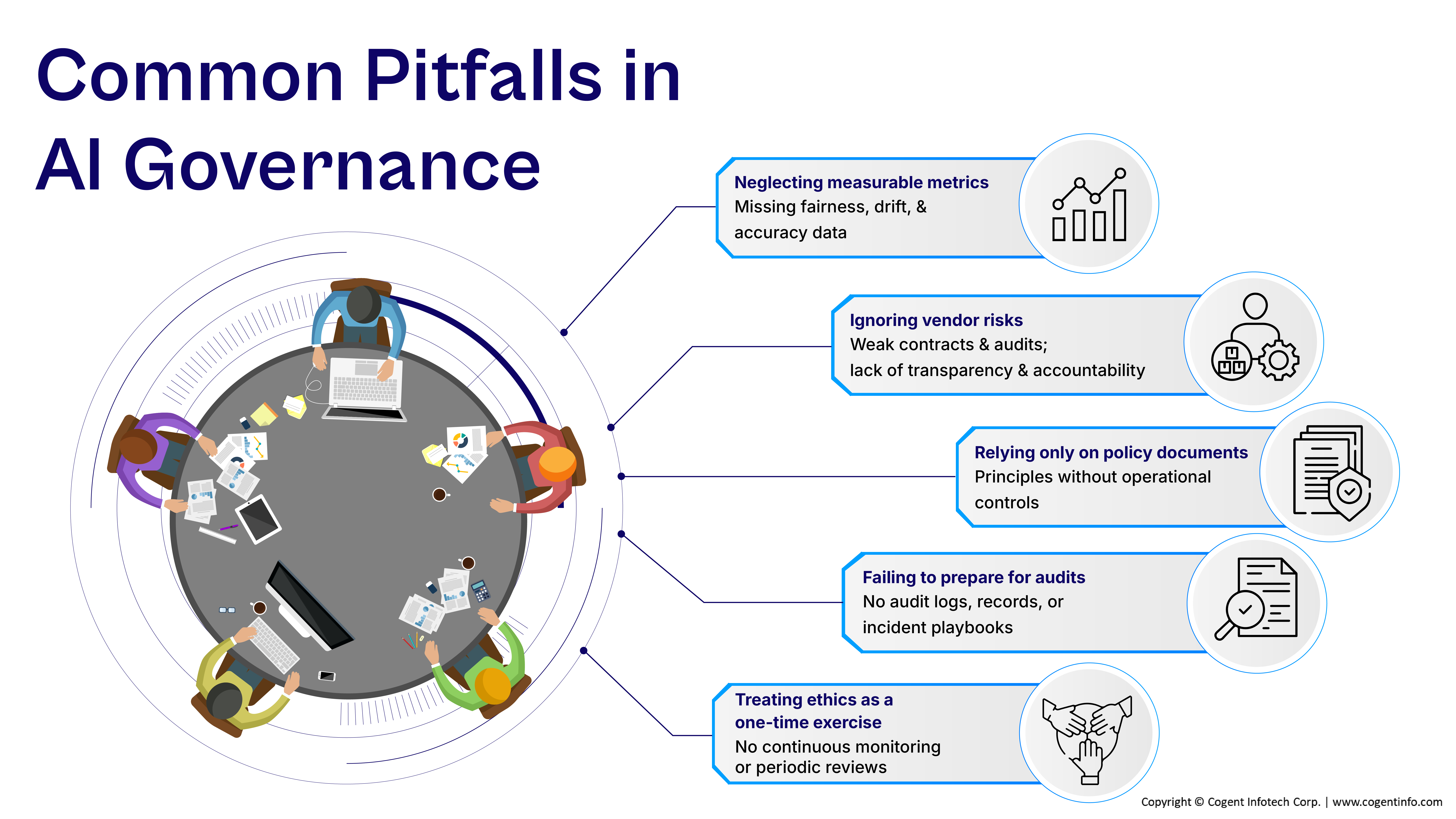
Even with the best intentions, many organizations stumble when putting AI governance into practice. By 2026, auditors and regulators have seen recurring patterns that undermine trust and compliance. Avoiding these mistakes is just as important as implementing new controls.
Frequent pitfalls include:
- Relying only on policy documents: Many enterprises still believe that publishing an AI ethics policy is enough. In reality, written principles without operational controls fail audits and do not reassure customers. Regulators now expect evidence of implementation, such as model inventories, monitoring dashboards, and incident playbooks. A policy without practice is seen as window dressing, not governance.
- Ignoring vendor risks: Third‑party providers often introduce vulnerabilities if contracts and audits are not enforced. For example, a vendor may train models on unverified data or fail to monitor bias, exposing the enterprise to reputational and regulatory risk. CIOs and compliance leaders must treat vendor governance as seriously as internal oversight, with clauses for transparency, audit rights, and accountability built into contracts.
- Treating ethics as a one‑time exercise: Some organizations run an ethics review at launch and then move on. Governance must be continuous, not a checklist completed once. Models evolve, data shifts, and risks emerge over time. Without ongoing monitoring and periodic reviews, enterprises risk drift, bias, and compliance failures that could have been prevented with sustained oversight.
- Neglecting measurable metrics: Without fairness, drift, and accuracy data, organizations cannot prove accountability. Metrics are the backbone of governance, providing the evidence regulators and customers demand. Enterprises that fail to measure consistently cannot demonstrate whether their models are performing responsibly. This leaves them exposed to reputational damage and regulatory penalties.
- Failing to prepare for audits: Auditors expect clear records of how models are governed. Lack of audit logs or incident playbooks leaves enterprises scrambling when reviews occur. Without documented evidence of decisions, updates, and interventions, organizations cannot prove compliance. This not only undermines trust but also increases the risk of fines and reputational harm.
For CIOs and compliance leaders, these mistakes highlight a simple truth: governance is not about documentation alone. It is about building systems that can withstand scrutiny and demonstrate accountability every day.
Conclusion
AI adoption is accelerating, but in 2026 the true measure of success is governance. CIOs, CISOs, and compliance leaders are expected to prove that their systems are trustworthy, auditable, and accountable. The trends outlined in this article show that governance has shifted from policy documents to operational controls, from principles to measurable evidence, and from isolated oversight to enterprise‑wide discipline.
The organizations that thrive will be those that embed governance into every stage of the AI lifecycle. They will treat models as critical assets, measure fairness and accuracy continuously, and demand accountability from vendors and partners. Most importantly, they will build trust with regulators, customers, and stakeholders by showing that responsible AI is not optional, but essential.
In 2026, AI governance is a critical business imperative. At Cogent Infotech, we help organizations embed transparency, accountability, and compliance into every stage of their AI lifecycle. Don’t wait for regulation to catch up.
Contact Cogent Infotech now to future-proof your AI and lead with confidence in a governance-driven world.