AI’s Next Act: 4 AI Trends That Will Redefine 2026



Introduction: Why 2026 Is a Reset Year
2026 marks a reset year for enterprise AI. After years of experimentation and hype, organizations are now focused on scaling responsibly, optimizing costs, and embedding accountability. CIOs, CTOs, IT directors, and digital transformation leaders face a new reality: AI is no longer a side project. It is core infrastructure, and its governance, cost, and operational impact are board‑level concerns.
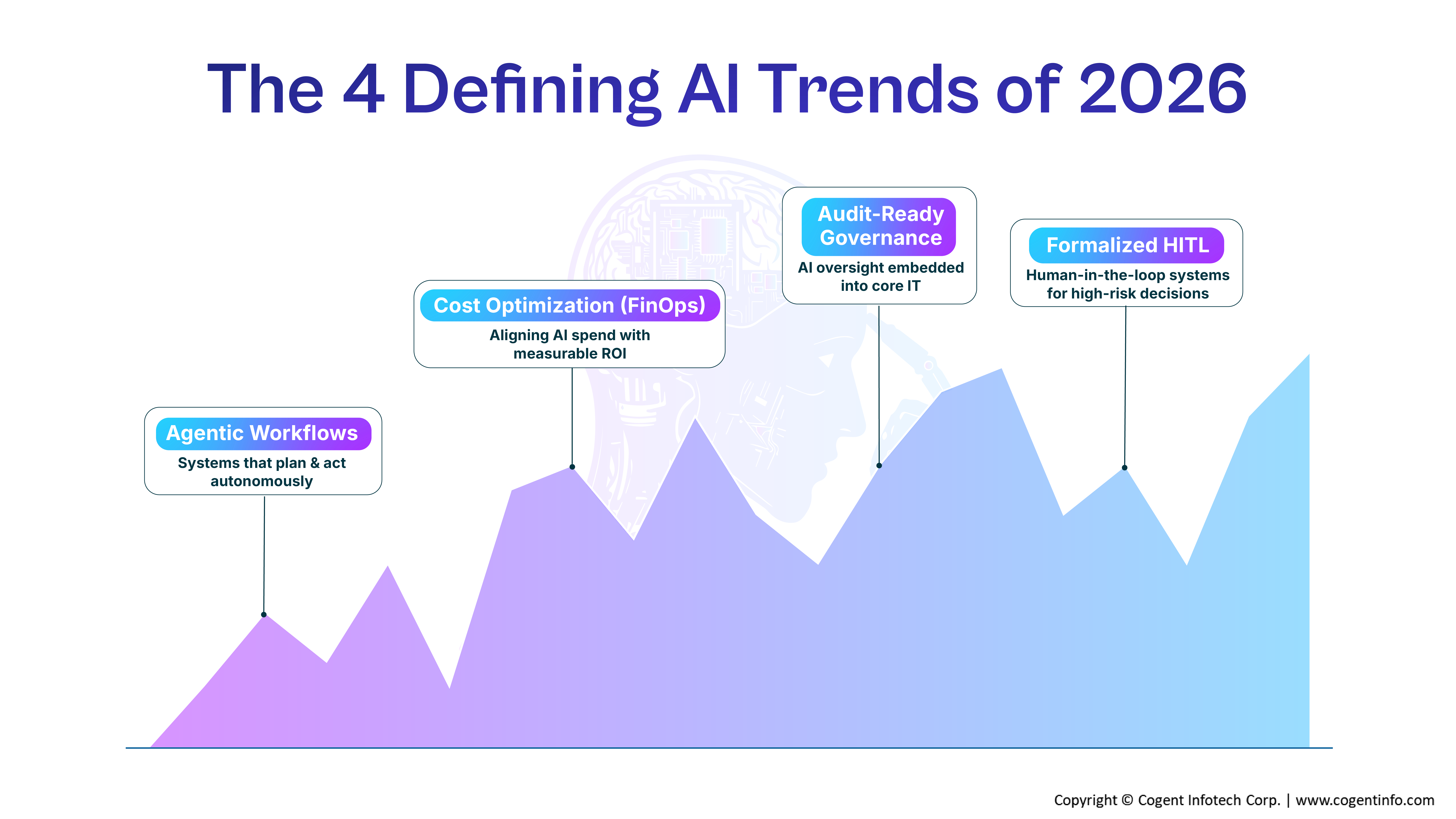
This article explores four defining AI shifts for 2026: agentic workflows, audit‑ready governance, AI cost optimization, and formalized human‑in‑the‑loop systems. Each trend is explained in terms of what it is, why it matters, and what leaders should do now. A practical checklist at the end provides immediate steps for IT leaders preparing for this next act of AI.
The first wave of enterprise AI was about experimentation. Chatbots, copilots, and generative models were deployed quickly, often without clear governance or cost discipline. By 2026, the landscape has changed. Boards, regulators, and customers now demand proof of accountability, efficiency, and trust.
AI is no longer judged by novelty but by impact. Enterprises must show that AI systems reduce operational friction, deliver measurable ROI, and operate safely under audit. This reset year is about moving from hype to impact, embedding AI into enterprise strategy with the same rigor as cybersecurity, financial controls, and compliance.
The Four AI Trends Defining 2026
AI in the enterprise is entering its next act. After years of pilots and hype cycles, 2026 is the year where impact outweighs experimentation. Leaders are no longer asking “Can AI do this?” but instead “How do we scale it responsibly, efficiently, and with trust?”
Trend 1: Agentic Workflows Become Mainstream
What It Is
Agentic AI refers to systems that don’t just respond to prompts but plan, act, and adapt workflows end‑to‑end. Instead of being passive copilots, these agents autonomously execute tasks such as scheduling, procurement, or customer support escalation. They can chain multiple steps together, monitor progress, and adjust actions dynamically.
Why It Matters
Agentic workflows unlock new productivity gains. Enterprises can automate complex processes that previously required human orchestration. For example, an agent could manage IT ticket resolution by diagnosing issues, escalating when needed, and closing tickets once resolved.
But with autonomy comes risk. Agentic AI introduces new surfaces for error, bias, and misuse. Without guardrails, agents could make unauthorized purchases, misinterpret compliance rules, or act outside intended boundaries. CIOs must balance speed with control.
What To Do Now
- Map high‑value processes - Identify repetitive workflows where agentic AI can cut manual effort, HR onboarding, IT ticket resolution, procurement approvals, or supply chain coordination. Focus on areas with high operational cost but low strategic risk to maximize early impact.
- Define guardrails - Set clear boundaries for autonomy. Agents should have permissions, escalation paths, and monitoring rules. For example, they can draft purchase orders but require human approval to finalize. Guardrails ensure agents know when to stop and hand off.
- Pilot in low‑risk domains - Test agentic workflows in safer areas like internal IT or employee onboarding before scaling to sensitive domains. Pilots allow leaders to refine guardrails, measure ROI, and build confidence with stakeholders.
- Build cross‑functional teams - Include IT, compliance, and business units in pilot oversight. Diverse perspectives help define success metrics, strengthen governance, and align AI capabilities with enterprise priorities.
- Document and share learnings - Capture insights from pilots and share them across teams. Documentation reduces duplication, accelerates maturity, and reassures boards and regulators that agentic AI is deployed responsibly.
Trend 2: AI Governance Becomes Core IT Governance
What It Is
AI governance is shifting from a separate discipline to a core component of IT governance. Just as cybersecurity and compliance are embedded into IT frameworks, AI governance is now expected to be audit‑ready and operational.
Why It Matters
Regulators and boards demand evidence that AI systems are governed with rigor. Model inventories, approval workflows, monitoring dashboards, and audit logs are no longer optional. Enterprises that fail to embed governance risk reputational damage, regulatory penalties, and customer distrust.
What To Do Now
- Build a central model inventory - Document every AI model, including its purpose, owner, and risk rating. A single inventory ensures visibility, reduces duplication, and provides auditors with proof that the organization knows exactly what AI is in use.
- Establish approval workflows - Require compliance and risk reviews before models go live. These checkpoints embed accountability, ensure fairness and accuracy, and create a documented trail of decisions that can be shown to regulators or boards.
- Integrate monitoring and audit logs - Deploy dashboards to track bias, drift, and performance in real time. Pair them with audit logs that record updates and interventions, giving leaders continuous oversight and evidence of responsible governance.
- Align governance with IT frameworks - Treat AI oversight as part of cybersecurity and compliance processes. Integrating governance into existing IT standards makes accountability consistent and efficient across technologies.
- Communicate practices to stakeholders - Share governance measures openly with boards, regulators, and customers. Transparency builds trust and positions the enterprise as a leader in responsible AI adoption.
Trend 3: AI Cost Optimization Goes Board‑Level
What It Is
AI FinOps, financial operations for AI, is emerging as a board‑level discipline. Enterprises must track usage, optimize model choice, and align spending with ROI.
Why It Matters
AI costs are rising sharply. Compute, storage, and licensing expenses can spiral without discipline. Boards now demand transparency and efficiency, treating AI spend like any other enterprise investment.
What To Do Now
- Track usage and costs - Use monitoring tools to capture compute, storage, and licensing consumption across teams. This visibility helps spot inefficiencies, prevent budget surprises, and forecast future AI expenses more accurately.
- Align model choice with ROI - Select models based on both technical performance and business value. Smaller, cheaper models may be sufficient for routine tasks, while premium models should be reserved for high‑stakes domains.
- Create executive reporting frameworks - Translate technical usage into financial terms boards can understand. Dashboards should show total spend, cost per project, and ROI metrics, making AI costs part of strategic decision‑making.
- Establish FinOps practices across teams - Make cost optimization a shared responsibility. Set budgets, assign ownership, and encourage efficient usage through cross‑functional collaboration between IT, finance, and business units.
- Benchmark and optimize continuously - Treat AI cost management as ongoing. Benchmark against peers, track improvements, and adjust strategies as models and infrastructure evolve to keep investments sustainable.
Trend 4: “Human‑in‑the‑Loop” Gets Formalized
What It Is
Human‑in‑the‑loop (HITL) systems ensure that AI decisions requiring oversight are reviewed by humans before execution. In 2026, this practice is becoming formalized, with clear escalation paths and accountability roles.
Why It Matters
Formal HITL reduces failures, builds trust, and ensures safer automation in sensitive domains such as healthcare, finance, and public services. It also satisfies regulators who demand evidence of human oversight in high‑risk decisions.
What To Do Now
- Define decision boundaries - Set clear rules for which AI outputs need human review, such as financial approvals, medical diagnoses, or compliance checks. This prevents over‑automation and ensures accountability in sensitive areas.
- Train staff on intervention protocols - Equip employees to recognize questionable outputs and step in effectively. Training should cover pausing automation, escalating issues, and documenting interventions for consistency and audit readiness.
- Document escalation workflows - Create workflows that specify who reviews AI outputs, how escalations are handled, and what evidence is logged. Documentation ensures oversight is systematic and regulator‑ready.
- Embed HITL into governance frameworks - Integrate human oversight into broader IT governance alongside cybersecurity and compliance. This makes HITL practices scalable and consistent across departments.
- Use HITL as a trust‑building tool - Communicate oversight practices to regulators, boards, and customers. Transparency builds confidence and positions the enterprise as a responsible AI adopter.
If You’re an IT Leader, You Can Begin Here
Preparing for AI’s next act requires moving from experimentation to discipline. CIOs, CTOs, and compliance leaders don’t need to solve everything at once, but they do need to show regulators, boards, and customers that governance, efficiency, and accountability are already in motion. These four immediate steps form the foundation for responsible, scalable AI in 2026:
Inventory your AI models and owners
The first step is visibility. Without a clear inventory, leaders cannot govern what they don’t know exists. Document every AI model in use across the enterprise, noting its purpose, owner, and risk rating. This creates a single source of truth for audits and ensures accountability is tied to specific individuals or teams. A well‑maintained inventory also helps identify duplication, shadow AI projects, and opportunities for consolidation.
Set up approval and monitoring workflows
AI models should not go live without formal checkpoints. Establish workflows that require compliance and risk reviews before deployment. Monitoring dashboards should track performance, bias, and drift continuously, with alerts for anomalies. These workflows embed governance into daily operations, ensuring that oversight is active rather than reactive. Approval processes also create a documented trail that can be presented to auditors or regulators as evidence of accountability.
Track AI costs with FinOps discipline
AI spending is rising rapidly, and boards are demanding transparency. Apply FinOps principles to AI by tracking compute usage, licensing, and model costs across teams. Align model selection with business ROI, not just technical performance. For example, a smaller, cheaper model may deliver sufficient accuracy for certain tasks, reducing unnecessary expenses. Reporting frameworks should make AI costs visible at the executive level, enabling informed decisions and preventing budget surprises.
Formalize human‑in‑the‑loop escalation paths
Automation without oversight is a recipe for risk. Define clear boundaries for when AI decisions require human review, such as loan approvals, medical diagnoses, or compliance checks. Train staff on intervention protocols so they know when and how to step in. Document escalation workflows to ensure accountability is clear and auditable. Formalizing human‑in‑the‑loop practices builds trust with regulators and customers while reducing the likelihood of costly failures.
These actions are not about perfection. They are about building momentum and demonstrating readiness. Within 90 days, organizations that take these steps can show regulators, boards, and customers that AI is being governed responsibly, costs are under control, and oversight is embedded. This foundation allows enterprises to scale AI confidently and sustainably in 2026.
Common Mistakes to Avoid
Even with momentum, enterprises often stumble when embedding AI into their operations. By 2026, regulators and auditors have seen recurring patterns that undermine trust and compliance. Avoiding these pitfalls is just as important as implementing new controls.

Treating AI as hype, not infrastructure
Too many organizations still view AI as a novelty project rather than core enterprise infrastructure. Without embedding governance, monitoring, and cost discipline, AI initiatives quickly fail audits or lose executive support. Treating AI as hype leads to fragmented deployments, shadow projects, and wasted investment. Leaders must shift mindset: AI is now as critical as cybersecurity or ERP systems, requiring enterprise‑wide standards and accountability.
Ignoring vendor risks
Third‑party providers often introduce vulnerabilities if contracts and audits are not enforced. For example, a vendor may train models on unverified data or fail to monitor bias, exposing the enterprise to reputational and regulatory risk. CIOs and compliance leaders must ensure vendors meet the same standards as internal teams. This means updating contracts with transparency clauses, audit rights, and clear accountability for responsible AI practices. Vendor governance is no longer optional, it is a frontline defense.
Neglecting measurable metrics
Without fairness, drift, and accuracy data, organizations cannot prove accountability. Metrics are the backbone of governance, providing evidence regulators and customers demand. Enterprises that fail to measure consistently cannot demonstrate whether their models are performing responsibly. This leaves them exposed to reputational damage and regulatory penalties. Leaders should prioritize dashboards that track bias, accuracy, and drift continuously, with corrective actions documented.
Failing to prepare for audits
Auditors expect clear records of how models are governed. Lack of audit logs or incident playbooks leaves enterprises scrambling when reviews occur. Without documented evidence of decisions, updates, and interventions, organizations cannot prove compliance. This not only undermines trust but also increases the risk of fines and reputational harm. Preparing for audits means embedding logging, lineage tracking, and incident response into daily operations, not treating them as afterthoughts.
These mistakes highlight a simple truth: governance is not about documentation alone. It is about building systems that can withstand scrutiny and demonstrate accountability every day. Enterprises that avoid these pitfalls will be better positioned to scale AI responsibly, earn customer trust, and satisfy regulators.
Conclusion and Reflection
2026 is the year AI fully matures into enterprise infrastructure. The experimental phase has ended, and organizations must now treat AI with the same rigor as cybersecurity, compliance, and financial systems. Agentic workflows, audit‑ready governance, disciplined cost optimization, and formalized human oversight are no longer optional, they are the foundation for scaling responsibly and sustainably.
For CIOs and IT leaders, the challenge is not just deploying AI but proving accountability, efficiency, and trust. The real test is whether your systems can withstand external scrutiny and deliver measurable business outcomes.
Reflection question for IT leaders: If regulators or customers audited your AI tomorrow, could you demonstrate:
- Accountability: Clear ownership, governance workflows, and audit logs for every model.
- Efficiency: Transparent cost tracking and ROI discipline aligned with enterprise priorities.
Trust: Evidence of fairness, oversight, and human‑in‑the‑loop safeguards in sensitive decisions.
Ready to Embrace AI's Next Act?
As 2026 marks a reset year for enterprise AI, it’s time for businesses to scale AI responsibly and strategically. At Cogent Infotech, we’re here to help you navigate this new AI landscape with robust governance, cost optimization, and accountability measures that align with your enterprise goals.
Is your AI ready for scrutiny? Let's work together to ensure your systems are built for long-term success, whether it’s implementing agentic workflows, formalizing human-in-the-loop processes, or establishing an audit-ready governance framework.
Get in touch with us today to start building a more responsible, efficient, and scalable AI infrastructure for your organization. Let’s take your AI to the next level.
Contact Cogent Infotech and ensure your AI systems are fully prepared for 2026 and beyond.