Why 2026 Will Be the Year Enterprises Move from Public AI to Private AI


Introduction
Over the last three years, public AI platforms have changed how the world works. Marketing teams draft campaigns in minutes. Sales leaders analyze pipelines through conversational dashboards. Product managers brainstorm roadmaps with a prompt. What once required entire departments now happens in a single chat window.
For enterprises, this shift felt revolutionary. Public AI tools lowered the barrier to experimentation and helped teams move faster than ever. But as organizations tried to embed these tools into real workflows, customer service, financial modeling, product design, HR, legal, the cracks began to show.
The problem is not capability. Public AI models are becoming increasingly powerful every quarter. The problem is fit. Enterprises do not operate in open environments. They deal in proprietary data, regulated information, and high-stakes decisions. A system designed for general use struggles when placed inside a complex business ecosystem.
By 2025, most large organizations had already placed informal limits on how employees use public AI tools. Some banned them outright. Others created shadow policies that restricted what could be uploaded or generated. Innovation slowed. Friction increased.
This is why 2026 will mark a turning point.
Enterprises will not abandon AI. They will re-architect it. Instead of relying on shared, public systems, they will build private, controlled, enterprise-grade AI environments that mirror how they already manage cloud infrastructure, data platforms, and security stacks.
This blog explores why that shift is inevitable. It examines where public AI breaks down inside enterprises, what “private AI” truly means, and why 2026 becomes the inflection point for business leaders. It also looks at how industries will adopt this model and what organizations must do now to prepare.
The Early Promise of Public AI in Business
Public AI platforms arrived at the perfect moment. Enterprises already struggled with information overload, tool sprawl, and slow decision cycles. When conversational AI became accessible, it felt like a universal interface for knowledge.
Teams used it to:
- Draft content at scale
- Summarize dense reports
- Analyze customer feedback
- Generate code and test cases
- Explore new product ideas
The appeal went beyond productivity. These tools democratized intelligence. Junior employees could perform tasks that once required specialists. Cross-functional teams spoke the same analytical language. The barrier between “technical” and “non-technical” roles shrank.
Many organizations treated public AI as an innovation sandbox. Leaders encouraged experimentation. Hackathons flourished. Internal prompt libraries formed. The narrative focused on speed and creativity.
But innovation inside enterprises carries weight. Every system touches real customers, revenue, and brand reputation. What felt magical in isolation became complicated at scale.
Where Public AI Begins to Break Down
Public AI platforms serve millions of users simultaneously. They optimize for generalization, not specificity. That design choice creates friction inside enterprise environments.
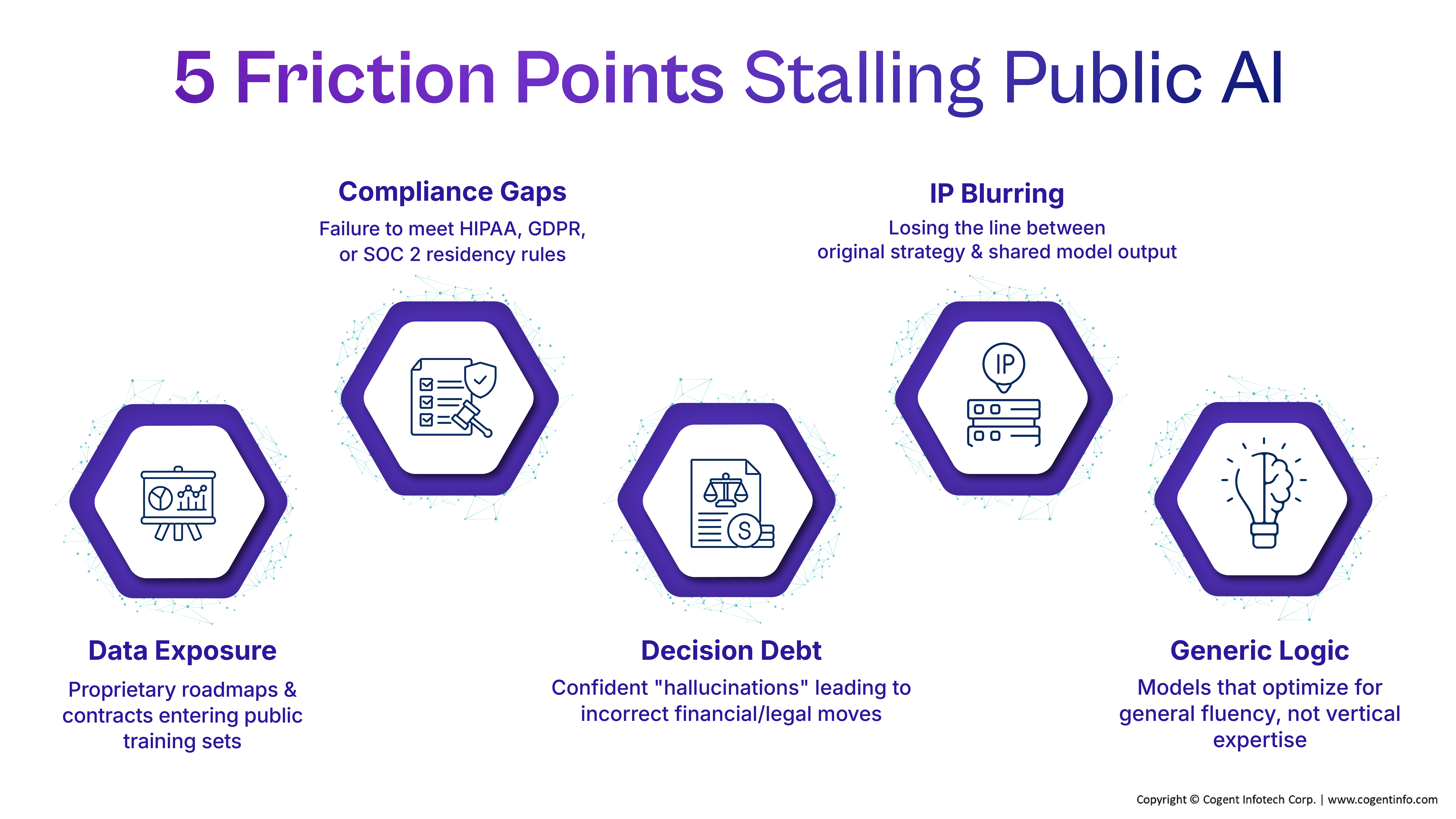
Data Exposure and Ownership
Enterprises operate on proprietary data: customer records, pricing models, legal contracts, product roadmaps, and internal research. When employees paste this information into a public AI system, they create a hidden channel of risk.
Consider a common scenario. A product manager uploads a draft roadmap into a public AI tool to refine messaging for leadership. The document contains launch timelines, partner names, and revenue assumptions. No policy explicitly forbids this action. The intent is productivity. Yet the company has now lost visibility over where that information travels, how long it persists, and who may indirectly access it.
Even when providers promise not to train on enterprise data, leaders still face unanswered questions:
- Where does the data travel?
- Who can access it?
- How long does it persist?
- What happens during a breach?
For a business leader, uncertainty itself becomes a blocker. Strategy cannot depend on “probably safe.”
Gartner consistently identifies data governance as the primary barrier to enterprise AI adoption, emphasizing that trust and control outweigh raw performance in boardroom discussions (Gartner, 2024). Leaders do not resist AI because it underperforms. They resist because they cannot see it.
In competitive markets, data equals advantage. When that advantage leaves the organization’s perimeter, even temporarily, it weakens the strategic position. Private AI restores ownership by design. Intelligence operates where the data already lives, under the same rules that protect every other enterprise asset.
Regulatory and Compliance Pressure
Industries like healthcare, finance, and insurance operate under strict regulatory frameworks. HIPAA, GDPR, SOC 2, PCI DSS, and emerging AI regulations require auditable systems and deterministic behavior.
Public AI tools cannot guarantee:
- Where data resides geographically
- How long will it remain stored
- Whether outputs comply with domain-specific rules
- How decisions can be traced or explained
A marketing team might accept ambiguity. A compliance officer cannot.
As governments introduce AI governance frameworks, enterprises must demonstrate control over training data, inference paths, and model behavior. Public AI platforms abstract away these layers.
That abstraction becomes a liability.
Intellectual Property Risk
Enterprises compete on differentiation. Their advantage lies in process knowledge, customer insight, and proprietary workflows. When teams rely on public AI, they risk:
- Embedding external logic into internal strategy
- Losing ownership of generated artifacts
- Blurring the line between original work and shared model output
McKinsey notes that organizations increasingly view AI not as a tool but as a strategic asset whose value depends on exclusivity and contextualization (McKinsey & Company, 2024).
Hallucinations and Business Risk
Public AI models are designed for fluency. They respond quickly, confidently, and persuasively. What they are not designed for is truth within a specific business context.
In casual use, hallucinations feel harmless. In enterprise environments, they accumulate as decision debt. Every confident but incorrect output enters a workflow that assumes reliability, and over time, those small inaccuracies compound into material risk.
Consider a finance team that asks an AI tool to summarize recent regulatory changes affecting revenue recognition. The response sounds authoritative and well-structured. It includes subtle errors that go unnoticed. Leadership uses the summary to adjust the reporting strategy. Weeks later, auditors flag inconsistencies. What began as a productivity shortcut becomes a compliance event.
Business leaders expect systems to behave predictably. They need guardrails, domain constraints, and verifiable outputs. They rely on tools that reflect institutional knowledge, not generic patterns drawn from the open internet.
Public AI platforms offer limited ability to define these boundaries. They operate outside the organization’s context. They cannot distinguish between what is generally plausible and what is permissible within a specific regulatory or operational framework.
Private AI changes this relationship:
- Models operate within defined knowledge domains
- Responses draw from approved, traceable data sources
- Behavior aligns with policy, process, and compliance rules
- Errors become observable, correctable, and improvable
This reframing transforms AI from a creative assistant into an operational system, one that supports judgment rather than improvising it.
Lack of Strategic Alignment
Public AI tools remain horizontal. They treat every user as generic. Enterprises, however, operate vertically.
A retail organization wants AI that understands merchandising logic, seasonal demand, supply chain constraints, and customer behavior. A manufacturing firm needs AI grounded in equipment telemetry, maintenance schedules, and quality benchmarks. Public models can approximate these domains. They cannot internalize them.
As organizations mature in their AI adoption, they stop asking, “What can this model do?” and start asking, “How does this model think like us?”
That shift requires ownership.
The Executive Reality Check
By late 2024, many enterprises arrived at a shared, unspoken understanding. Public AI had proven its value as a catalyst for exploration, but it struggled to support the weight of real operations. Teams experimented with enthusiasm, yet core workflows remained largely untouched. Legal and IT functions grew more cautious, while business units continued to move ahead without consistent guardrails. Innovation persisted, but it lacked structure, ownership, and long-term stability.
Leaders began noticing familiar patterns across the organization:
- Employees hesitated to use AI for core work
AI felt helpful for drafts and ideation, but unreliable for decisions that carried business risk. - Legal teams introduced restrictions after adoption had begun
Policies followed behavior, creating friction between momentum and compliance. - IT departments created informal controls
Shadow guidelines emerged to manage tools that were never designed for enterprise governance. - Innovation remained fragmented
Progress appeared in isolated pockets, without a shared architecture or direction.
Over time, the distance between experimentation and enterprise-grade deployment became harder to ignore. AI raised individual productivity, yet it did not mature into an institutional capability. Teams moved forward in isolation while governance lagged, creating a landscape where momentum consistently outpaced structure.
Gradually, a strategic choice came into focus. Organizations could continue limiting usage to manage risk, or they could redesign their AI foundation to meet enterprise standards.
Private AI does not discard what public platforms made possible. It absorbs those capabilities and brings them inside the organization’s architecture, policies, and data boundaries. This shift extends beyond technology. It represents a deliberate rethinking of how intelligence moves through the enterprise and who shapes it.
The sections that follow explore what private AI truly means, why 2026 becomes the inflection point, how industries will lead this transition, and how business leaders can begin preparing today.
What “Private AI” Really Means for Enterprises
Private AI does not mean building a model from scratch in a basement server room. It means creating an AI environment that behaves like an enterprise system rather than a consumer app.
Most organizations still approach AI with a tool mindset. They evaluate features, compare interfaces, and think in terms of user access. Private AI requires a platform mindset. Intelligence becomes part of the organization’s architecture, alongside data platforms, identity systems, and ERP environments.
In practice, private AI allows organizations to:
- Host models within their own cloud or data centers
- Control training data and fine-tuning pipelines
- Define domain rules and behavioral constraints
- Integrate deeply with internal systems
- Monitor, audit, and govern every interaction
IBM describes this shift as moving from “general-purpose AI” to “purpose-built enterprise AI,” in which models operate within defined trust boundaries and align with organizational goals (IBM, 2024).
For business leaders, this changes the conversation. AI no longer sits on the edge of workflows. It becomes embedded in decision-making, customer interactions, and operational systems.
Private AI allows enterprises to design intelligence that understands:
- Their data schema
- Their risk tolerance
- Their compliance obligations
- Their strategic priorities
Instead of reacting to every output with, “Is this safe?” leaders begin designing systems that cannot behave unsafely by default. Safety becomes structural, not situational.
That shift marks true maturity. It shows an organization has moved from using AI to governing intelligence, from managing risk after it appears to engineering trust into every interaction.
Why 2026 Becomes the Inflection Point
The shift toward private AI is already underway. What sets 2026 apart is convergence.
By 2024 and 2025, most enterprises moved through an experimentation phase. Teams tested tools. Leaders saw measurable productivity gains. Legal and IT functions introduced boundaries. Then a different pattern emerged. Momentum slowed as enthusiasm collided with risk. Innovation did not stop, but it stalled in a gray zone between possibility and permission.
2026 becomes the year organizations move from exploration to execution where several forces begin to align:
- Regulatory frameworks solidify
Governments shift from discussion to enforcement. Enterprises must demonstrate governance, traceability, and control over AI behavior and data. - Enterprise-grade tooling matures
Secure model hosting, fine-tuning pipelines, vector databases, and orchestration layers now resemble familiar enterprise platforms rather than experimental tools. - Cloud economics stabilize
Running models privately becomes predictable. Intelligence can be budgeted like compute or storage. - Executive expectations shift
Boards move past the question of whether AI matters. They focus on how it differentiates the business. - Operational dependency increases
AI begins to shape forecasting, pricing, fraud detection, and customer engagement. At this level, shared infrastructure feels misaligned with business risk.
Red Hat observes that enterprises increasingly view AI infrastructure as core architecture rather than experimental tooling (Red Hat, 2024). Once intelligence becomes operational, control becomes non-negotiable, and that’s where 2026 stands out as the point where organizations stop treating AI as a series of pilots and begin building it as a foundational enterprise platform.
How Industries Will Lead the Transition and Why Ownership Becomes a Strategic Advantage
The shift toward private AI will not happen evenly across sectors. Industries that operate under regulatory pressure, data sensitivity, and operational precision will lead first. For them, public AI is not a shortcut; it is a constraint.
.png)

Healthcare
Healthcare organizations manage some of the most sensitive data in the economy. Public AI tools struggle to comply with HIPAA and other patient privacy frameworks. Private AI enables:
- Clinical documentation summarization inside EHR systems
- Patient communication models grounded in policy
- Diagnostic support trained on institution-specific data
These systems operate within audit trails and compliance frameworks. AI becomes a clinical assistant, not a risk vector.

Banking and Financial Services
BFSI leaders already treat data as regulated capital. Private AI supports:
- Fraud detection models trained on proprietary transaction patterns
- Credit assessment grounded in internal risk models
- Personalized financial guidance within compliance boundaries
McKinsey highlights that financial institutions gain the highest ROI when AI integrates into core decision engines rather than surface-level chat tools (McKinsey & Company, 2026). In this environment, intelligence must be owned to remain accountable.

Manufacturing
Manufacturers depend on precision. Private AI enables:
- Predictive maintenance using machine telemetry
- Quality inspection models trained on defect patterns
- Supply chain forecasting grounded in internal logistics data
Public models cannot internalize factory-specific context. Private AI can.

Retail and Consumer Brands
Retailers operate on differentiation. Private AI allows:
- Demand forecasting tuned to brand behavior
- Personalization engines trained on first-party data
- Pricing strategies grounded in proprietary analytics
The model becomes part of the brand experience rather than a generic assistant.
Why Ownership Becomes a Strategic Advantage
Across these industries, a clear pattern emerges: the more central AI becomes to decision-making, the less tolerance enterprises have for shared infrastructure.
When organizations own their AI layer, they gain:
- Differentiation: Models reflect internal knowledge and proprietary workflows
- Trust: Outputs align with policy, compliance, and business context
- Speed: Intelligence integrates directly into operational workflows
- Resilience: Systems operate independently of public platforms
- Governance: Leaders can audit, refine, and evolve behavior over time
NIST emphasizes that trustworthy AI requires accountability, transparency, and control at the system level, not just at the output level (National Institute of Standards and Technology, 2023).
Private AI transforms intelligence from a utility into a competitive moat.
Conclusion
Public AI opened a door for enterprises. It made advanced intelligence accessible and revealed how dramatically work could change. For many organizations, it became the first tangible glimpse of what an AI-enabled future might look like.
As AI moves closer to the center of strategy, operations, and customer experience, a different realization begins to take shape. Lasting advantage does not come from access alone. It comes from how deeply intelligence is woven into the fabric of the business. Systems that sit outside the enterprise can inspire new ways of working, but they cannot fully embody how an organization thinks, decides, and competes.
Private AI reflects this evolution. It shifts intelligence from something organizations borrow to something they shape. It brings governance, differentiation, and trust into the same design space, allowing enterprises to define how machines reason within their own context.
2026 will not signal the disappearance of public AI. It will mark the point at which enterprises begin to outgrow it. The organizations that lead this transition will be those that move beyond using intelligence and start designing it into who they are.
Prepare Your Enterprise for the 2026 AI Inflection Point
The shift to private AI is not a technology upgrade. It’s a strategic redesign of how intelligence flows through the enterprise. Organizations that prepare now will lead tomorrow. Cogent Infotech works with business and technology leaders to create secure, compliant, and scalable AI foundations that turn intelligence into a lasting competitive advantage.
Start your private AI journey with Cogent Infotech today.