Preemptive Cybersecurity: Shifting from AI-Detection to AI-Prediction by 2026



Introduction: The Shift Toward Predictive Cybersecurity
The global cybersecurity landscape is undergoing a fundamental transformation driven by the rapid evolution of artificial intelligence and the increasing complexity of digital threats. Traditional security models that focus on detecting and responding to incidents after they occur are struggling to keep pace with adversaries that now operate at scale with automation, speed, and intelligence. From AI-powered phishing and automated malware generation to deepfake impersonation and sophisticated lateral movement strategies, modern cyberattacks have significantly narrowed the window between intrusion and impact.
This blog explores the critical shift from AI-based threat detection to AI-powered prediction and why this evolution is shaping the future of enterprise cybersecurity by 2026. It examines how predictive security enables organisations to anticipate attack paths, assess risk accumulation in real time, and intervene before threats materialise into full-scale breaches. The discussion outlines the strategic, technical, and operational foundations required to make predictive cybersecurity effective, scalable, and trustworthy.
By analysing why detection alone is no longer sufficient, how predictive systems operate, and the technological and market forces accelerating their adoption, this blog provides a comprehensive view of how enterprises can move toward a proactive security posture. The objective is to highlight practical pathways for organisations seeking to enhance resilience, reduce breach probability, and align cybersecurity strategy with the realities of an AI-driven threat ecosystem.
Why Detection Alone Falls Short
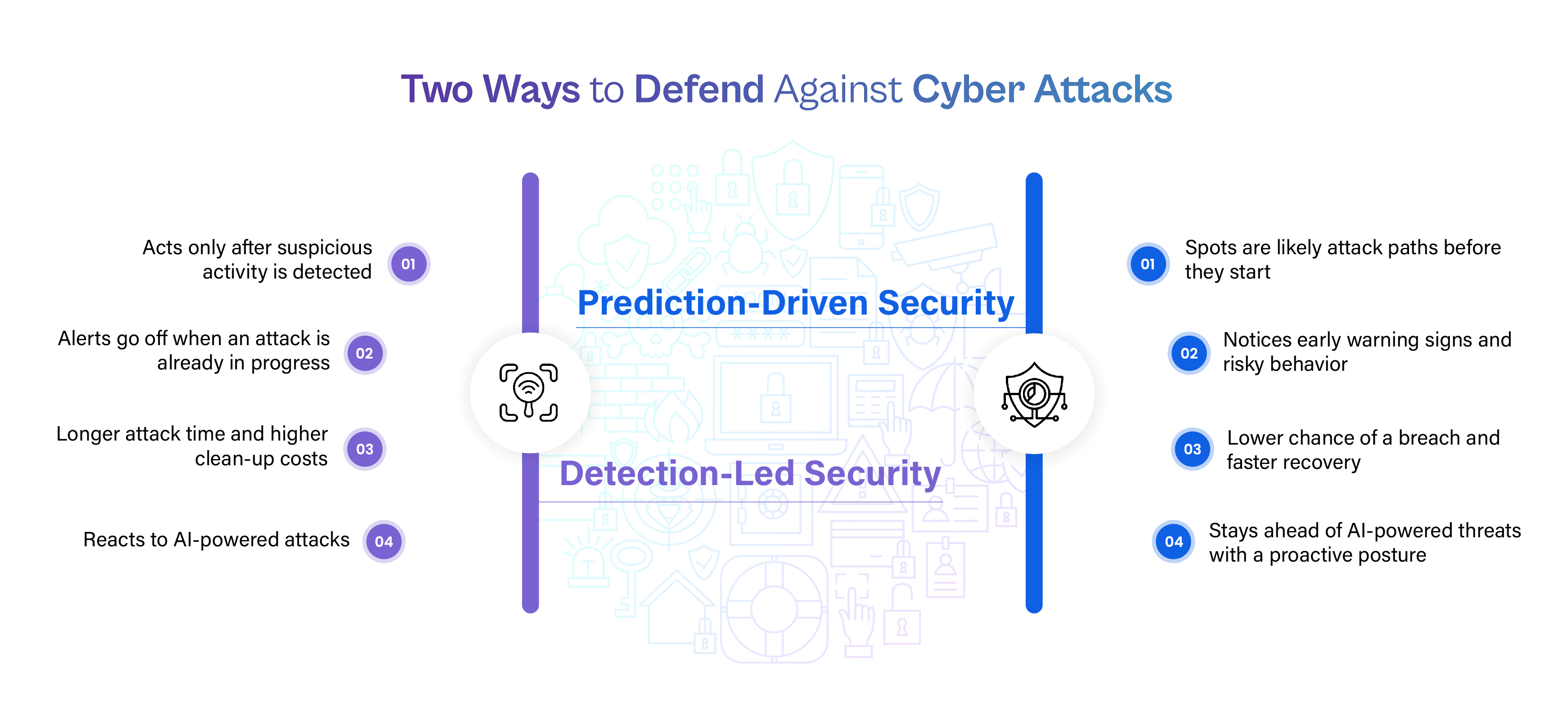
Traditional cybersecurity approaches remain focused on identifying threats after suspicious activity has already begun. Endpoints trigger alerts, security information and event management systems raise flags, and analysts initiate investigations. While this process continues to play a vital role in incident response, its ability to safeguard organisations has steadily weakened as threat actors evolve faster than response mechanisms. Detection systems operate after the initial breach vector has already been activated, leaving limited time to minimise damage and contain lateral movement.
Modern cyber adversaries increasingly rely on generative AI, automation, and intelligent attack frameworks to accelerate operations and bypass static controls. AI-powered phishing campaigns now demonstrate higher levels of personalisation, voice cloning, and context awareness, making them more convincing and difficult to detect early.
Malware generation has also become more automated, allowing attackers to deploy highly customised payloads at scale. As highlighted in Google Cloud’s Cybersecurity Forecast 2026, attackers are transitioning toward making AI an integral part of their standard operational toolkit rather than an experimental capability. This evolution narrows the window between reconnaissance and exploitation, creating scenarios in which critical systems are already compromised before security teams receive alerts.
Industry analysts view this progression as a structural problem in detection-centric security models. Gartner identifies preemptive cybersecurity and AI security platforms as top strategic technology trends for 2026, reflecting a broader understanding that organisations must adopt forward-looking defenses to remain resilient.. When detection functions as the primary line of defense, the organization shoulders a persistent risk of prolonged dwell time, higher remediation costs, data exposure, and reputational fallout. Predictive security addresses this gap by enabling earlier intervention, improved risk prioritisation, and stronger resilience against emerging threats that operate at machine speed.
What AI-Prediction Means in Cybersecurity
Prediction in cybersecurity extends far beyond improved anomaly detection or faster alerting. It refers to a strategic intelligence system that anticipates risk patterns, evaluates likely attack trajectories, and enables controlled preventive action within clearly defined governance structures. Rather than responding to threats after behavioural deviations have already occurred, predictive security focuses on understanding intent signals and translating them into forward-looking risk insights.
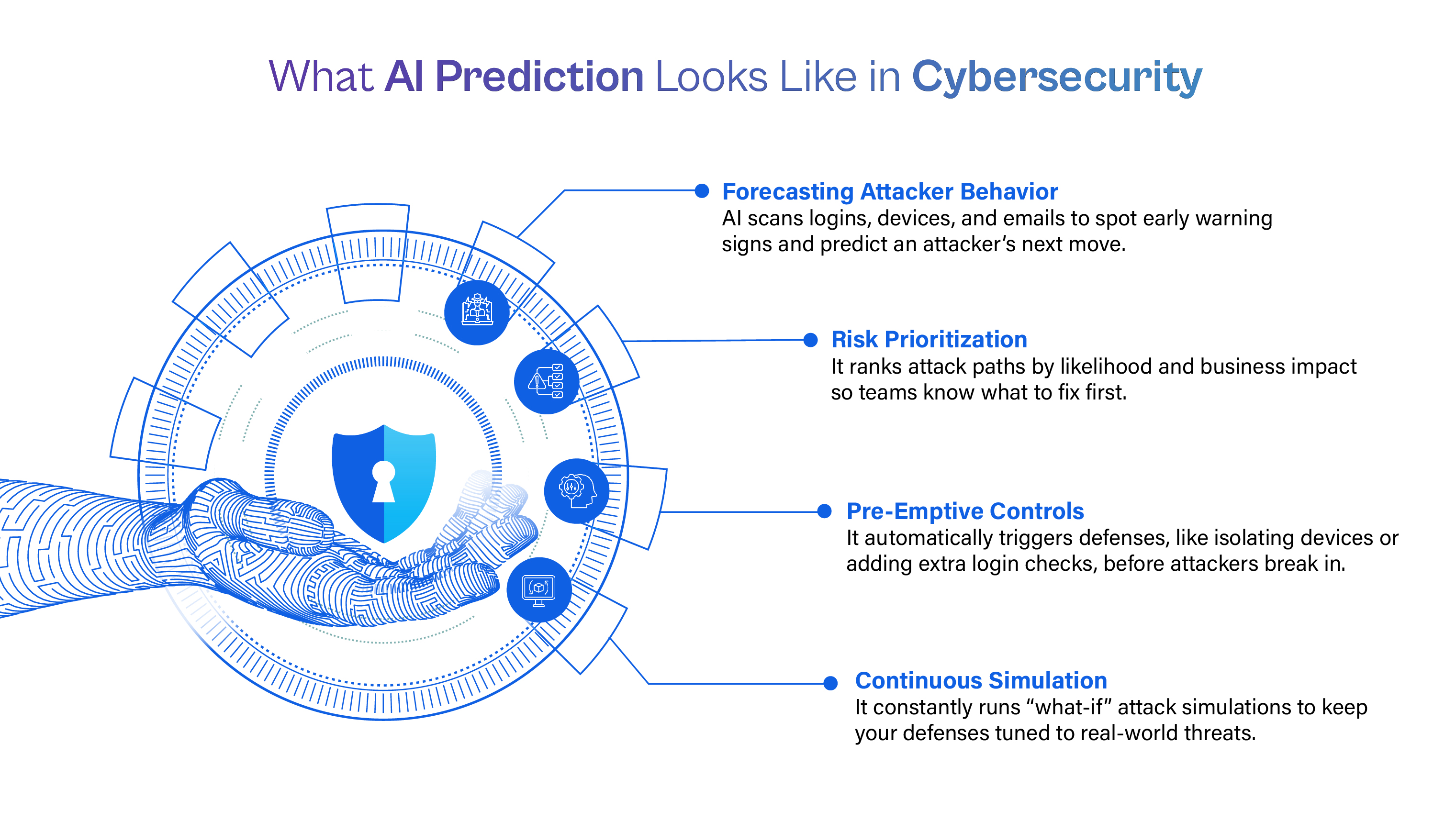
Forecasting adversary behaviour
By identifying early indicators such as unusual MIME types in email attachments, irregular credential activity, or unfamiliar device registrations, AI models analyse sequences of behaviour to anticipate the most probable next steps an attacker may take. These steps often include lateral movement, privilege escalation, or data exfiltration. This capability is strengthened by frameworks such as the MITRE ATT&CK knowledge base, which systematically categorises attacker tactics and techniques. Through this structure, security teams gain a method to evolve from analysing past incidents to anticipating future threat actions.
Risk prioritisation by probability and business impact
Predictive systems introduce a more nuanced triage approach by assigning probability scores to potential attack paths and correlating them with the criticality of impacted assets. An anomaly affecting a low-priority test environment is evaluated differently from a developing pattern surrounding core infrastructure or revenue systems. This approach enables security teams to concentrate resources where predictive risk and business consequences intersect.
Pre-emptive or automated control adjustment
When AI models identify high-confidence threat patterns, predefined workflows initiate proportionate preventive measures. These may include throttling a suspicious session, isolating an endpoint, enforcing adaptive multi-factor authentication, or accelerating patch deployment for exposed systems. For instance, when a service provider detected reconnaissance patterns across identity access logs, the automated system triggered credential resets across high-risk identities, preventing lateral access before it could unfold.
Continuous simulation and red-teaming of attack paths
Many organisations now simulate hypothetical attack scenarios through digital twins of their infrastructure. These “what-if” environments allow security teams to model the progression of attacks from initial access to exploitation, test potential controls, and apply mitigations before real-world execution. This practice transforms static vulnerability assessments into actionable attack-path intelligence.
Taken together, these capabilities define the operational distinction between predictive security and traditional detection-driven approaches, positioning foresight as the foundation of modern cyber defense.
Why the Timing Works: Tech and Market Signals
Maturity of AI Infrastructure and Predictive Capabilities
The rise of predictive cybersecurity is strongly supported by the increasing maturity of artificial intelligence frameworks and computational infrastructure. Modern AI systems can now process large volumes of telemetry data across endpoints, cloud environments, and identity systems in near real-time. This capability enables security platforms to move beyond static rule evaluation and into behaviour-driven risk modelling.
Microsoft’s Digital Defense Report highlights that AI-based behavioural analysis is rapidly becoming the foundation of advanced threat detection and forecasting across enterprise ecosystems. The report indicates that organisations implementing predictive intelligence are better positioned to identify coordinated attack patterns spanning multiple digital surfaces. This suggests that the technical foundation for AI-prediction is no longer conceptual but increasingly operational.
Evolution of Threat Actor Sophistication
Threat actors are demonstrating higher levels of automation, intelligence, and speed. AI-powered phishing, deepfake impersonation, and automated reconnaissance have significantly reduced detection windows. AI-enabled cybercrime is identified as one of the most destabilising forces reshaping global security, with organisations facing unprecedented risks due to compressed response timelines and expanded attack vectors.
This evolution demands a move toward systems that anticipate exploitation before it manifests. Predictive cybersecurity provides this proactive capability by interpreting intent signals rather than waiting for confirmed breaches.
Shifting Enterprise Investment and Market Behaviour
Cybersecurity investments are undergoing strategic reallocation. Organisations are increasingly prioritising platforms capable of predictive modelling, attack path analysis, and automated response coordination over legacy signature-based systems. According to McKinsey & Company, enterprises are redirecting budgets toward integrated security ecosystems that support anticipatory threat mitigation and measurable cyber-resilience outcomes. This shift is further reinforced by board-level pressure for risk transparency and accountability. Predictive security allows leadership to assess likelihood-based risk rather than retrospective incident metrics, strengthening governance and decision-making frameworks.
Expansion of the Digital Attack Surface
Cloud adoption, distributed workforces, and hybrid IT infrastructures have dramatically increased the complexity of enterprise ecosystems. IBM’s X-Force Threat Intelligence Index notes that attackers increasingly exploit misconfigurations and early-stage vulnerabilities across interconnected systems, with delayed detection resulting in extensive lateral movement and greater impact.
Predictive cybersecurity enables organisations to anticipate and model these vulnerabilities, identifying potential exploit chains before they escalate into systemic compromise. This approach shifts the security posture from reactive response toward continuous threat anticipation.
Strategic Alignment and Industry Convergence
The convergence of advanced AI capabilities, evolving threat landscapes, budget prioritisation, and digital complexity forms a strategic tipping point for predictive security adoption. These forces collectively signal that the timing for transitioning to AI-powered prediction is aligned with technical feasibility, operational necessity, and enterprise readiness.
By 2026, predictive cybersecurity will no longer represent an advanced option reserved for mature organisations. It will serve as a baseline for enterprises seeking to protect critical data, ensure regulatory compliance, and maintain operational continuity in increasingly volatile digital environments.
Core Technical Building Blocks for Predictive Security
To operationalise predictive cybersecurity, organisations must develop an interconnected ecosystem of data, models, governance, and automation. These building blocks transform predictive theory into functional, enterprise-grade security capability.
Telemetry Fusion and Unified Data Architecture
A predictive security system depends on the quality, depth, and speed of its data inputs. Organisations must establish a unified telemetry lake that consolidates identity logs, endpoint signals, cloud audit trails, network flows, DNS activity, CI/CD pipeline data, IAM changes, and vulnerability scanner outputs. This architectural layer becomes the foundation on which predictive intelligence operates.
Effective telemetry fusion involves:
- Harmonising schemas and metadata formats across heterogeneous sources
- Creating scalable feature stores that enable real-time model queries
- Ensuring low-latency ingestion to support near-real-time threat forecasting
According to Cisco Talos threat researchers, organisations with unified telemetry platforms achieve significantly higher accuracy in identifying complex attack patterns spanning multiple systems than those using siloed monitoring tools. In one enterprise deployment, integrating cloud and on-premises identity logs into a centralised feature store enabled analysts to forecast credential spray behaviour and lateral movement attempts within minutes rather than hours, improving containment precision and response speed.
Threat Intelligence and Behavioural Baseline Integration
Predictive cybersecurity relies on the convergence of two primary data dimensions. External threat intelligence reflects evolving adversary behaviours, while internal behavioural baselines define what is considered normal within an organisation's ecosystem.
External intelligence includes:
- Known tactics, techniques, and procedures
- Infrastructure indicators
- Attacker tool signatures and behavioural patterns
Internal baselines quantify:
- Typical user login behaviour
- Service-to-service interaction patterns
- Host activity thresholds and time-based usage trends
The European Union Agency for Cybersecurity (ENISA) highlights that integrating external threat intelligence with internal behavioural context enables security teams to reconstruct potential attack chains and anticipate adversary progression before execution. By translating global threat patterns into locally relevant risk narratives, organisations achieve a higher level of contextual threat prediction.
Predictive Models and Simulation Engines
Three core model types power predictive cybersecurity:
Sequence modelling systems
These use machine learning architectures, such as transformers or recurrent neural networks, to identify temporal behaviour patterns and predict probable next-step actions. They enable forecasting of adversary progression across digital environments.
Graph-based risk analysis engines
These construct asset relationship maps that visualise connections among identity, system, and service components. By analysing interdependencies and privilege hierarchies, these models predict where an attacker is likely to move next, following the path of least resistance.
Digital twin simulation environments
These emulate real-world network conditions in controlled environments, allowing security teams to simulate attack scenarios and test defensive strategies before live deployment.
By integrating predictive analytics with simulation-driven attack modeling, organizations can detect potential breaches much earlier and prevent threats from escalating across interconnected systems. This combination strengthens proactive defense strategies by identifying vulnerabilities before they are exploited. As a result, security teams shift from reacting to incidents after damage occurs to anticipating threats and neutralizing them before they cause widespread disruption.
Explainability, Confidence Metrics, and Causal Logic
For automated prediction systems to function responsibly, their outputs must be interpretable and measurable. Security leaders must understand why a prediction was generated and how confident the system is in that forecast. Essential components include:
- Probability scoring for risk assessment
- Feature attribution explaining prediction rationale
- Causal mapping between behaviour and projected impact
Deloitte’s cybersecurity research emphasises that explainable AI plays a central role in gaining executive and operational trust in intelligent systems. Without transparency, automation risks overriding organisational judgement or creating blind operational dependence (Deloitte, 2023). Explainability ensures that security decisions remain accountable, auditable, and aligned with governance expectations.
Orchestration and Safe Automation Frameworks
Predictions must be acted on through orchestration systems such as SOAR or extended detection and response platforms. This step operationalises intelligence into real-world mitigation under defined guardrails.
Core design elements include:
- Playbooks with staged response logic and approval layers
- Human-in-the-loop oversight for high-impact interventions
- Circuit breakers to reverse automated decisions
- Comprehensive logging and forensic traceability
A Fortune 500 organisation implemented automated credential response when the prediction confidence exceeded 90%. Sessions were temporarily disabled, adaptive authentication triggered, and credentials re-provisioned under audit-controlled workflows. Over six months, lateral movement incidents reduced measurably, reinforcing the value of controlled automation in predictive defense strategies.
SANS Institute research confirms that organisations deploying structured SOAR automation with predictive trigger mechanisms experience decreased dwell time and faster threat containment than in manually orchestrated response environments. Taken collectively, these building blocks establish a scalable and resilient predictive cybersecurity architecture. By integrating telemetry consolidation, intelligent modeling, simulation frameworks, explainable reasoning, and automation pipelines, organisations lay the groundwork for security systems that actively anticipate attack trajectories rather than simply reacting to breach events.
Governance & Controls: Trust Before Action
Predictive automation promises efficiency but also introduces new risks. Governance must address these fundamental questions:
- Who authorises automated actions and at what confidence threshold?
- How are false positives minimised to avoid business disruption?
- How is model drift, adversarial manipulation, and bias managed over time?
- How are data privacy and compliance considered when ingesting telemetry?
Best-practice frameworks provide guidance. For example, the NIST AI RMF defines four core functions: Govern, Map, Measure,and Manage, applicable across the AI lifecycle. This aligns closely with how a predictive security programme must be structured (UpGuard, 2025). Ensuring audit trails, rollback capability, and human oversight ensures predictive automation does not become reckless.
High-Impact Predictive Security Use Cases in Real-World Environments
Predictive cybersecurity demonstrates its true value when applied to real operational scenarios where early intervention changes the outcome of an attack. These use cases show how AI-driven forecasting enables security teams to identify developing threat patterns, interpret early intent signals, and activate preventive controls before disruption or data loss occurs. Rather than reacting to confirmed breaches, organisations can intercept attack chains while they are still forming.
Credential-compromise forecasting
Signals such as geolocated login anomalies, irregular password-reset sequences, and abnormal multi-factor authentication behaviour often appear before lateral movement begins. A predictive engine recognises these correlated indicators and initiates preventive measures such as credential resets, temporary session restrictions, or stepped-up authentication protocols before unauthorised access escalates.
Supply-chain compromise early warning
A sudden increase in package metadata changes across CI/CD pipelines, combined with unknown IP access to build environments and anomalous deployment behaviour, may indicate a third-party compromise risk. Predictive systems flag this pattern and automatically quarantine affected pipelines, accelerating patch scheduling and additional integrity verification, thereby reducing the likelihood of corrupted code entering production.
Ransomware-path forecasting
Patterns such as excessive lateral movement, SMB share enumeration, and irregular file access spikes frequently precede ransomware execution. By identifying these sequences early, predictive systems isolate vulnerable segments, throttle suspicious file-sharing activity, and prioritise endpoint patch remediation, helping to contain potential encryption events before they reach critical systems.
API abuse and data exfiltration forecasting
A rapid generation of new API tokens from an established account, followed by abnormal request volumes and privilege escalation behaviour, may signal an attempt at data extraction. Predictive analysis detects this trajectory and responds by throttling API usage, enforcing account re-validation, and notifying security teams to intervene before sensitive data is exfiltrated.
These scenarios highlight how predictive security replaces reactive dependence with informed anticipation. By identifying patterns that indicate where an attack is headed, organisations shift from damage control to strategic prevention, strengthening operational resilience and reducing the window of exposure across critical systems.
How to Evaluate Predictive Cybersecurity Solution Providers
Choosing the right partner for predictive cybersecurity requires more than impressive marketing claims and technical jargon. Organisations must adopt a structured evaluation approach that prioritises capability, transparency, integration readiness, and measurable outcomes. A disciplined selection process helps separate scalable, enterprise-ready solutions from experimental tools with limited operational value.
Key evaluation considerations include:
- Telemetry ingestion breadth and processing speed
- Model explainability, confidence score transparency, and rollback mechanisms
- Alignment with recognised frameworks such as NIST AI Risk Management Framework and MITRE ATT&CK
- Vendor transparency around model training data, governance structures, and adversarial resilience measures
- Integration readiness with existing SOC, SOAR, and SIEM workflows
- Proof of concept delivery supported by measurable performance indicators such as incident reduction and improved mean time to response
As more vendors promote autonomous AI defence capabilities, rigorous validation through real-world proof-of-concept deployment remains essential. Industry analysis indicates that a significant proportion of agentic AI initiatives are likely to be discontinued due to inflated expectations and insufficient operational alignment, reinforcing the importance of evidence-based evaluation and disciplined adoption strategies.
Conclusion: From Reactive Defense to Anticipatory Resilience
The shift from detection-led security to prediction-driven defense marks a critical evolution in how organisations protect their digital environments. As cyber threats become more automated and intelligent, relying solely on reactive detection exposes systems to greater risk and slows response cycles. Predictive cybersecurity offers a forward-looking approach that enables enterprises to forecast attack paths, intervene earlier, and reduce the likelihood of high-impact breaches through controlled, intelligence-led prevention.
By investing in predictive models, unified telemetry, governance frameworks, and safe automation, organisations build a security posture that is resilient, scalable, and aligned with future risk realities. This approach strengthens operational continuity, enhances decision-making clarity, and positions businesses to meet the demands of an AI-driven threat landscape with greater confidence and strategic readiness.
Ready to move from reacting to threats to preventing them?
Discover how Cogent Infotech helps enterprises adopt predictive cybersecurity strategies powered by AI, intelligent automation, and risk-led governance. Connect with our experts to explore how anticipatory security can strengthen your resilience, reduce breach risk, and prepare your organization for the threat landscape of 2026 and beyond.
Contact Now.