The Workforce Trends That Will Define Hiring Strategies in 2026


The Workforce Trends That Will Define Hiring Strategies in 2026
Hiring in 2026 won’t resemble what it looked like even two years ago. The market is moving faster, skills are evolving in shorter cycles, AI is reshaping workflows, candidate expectations are shifting, and organisations still relying on legacy hiring playbooks are already losing ground. The opportunity is not simply to “keep up,” but to rebuild hiring as a strategic system, one that is skills-aligned, data-informed, human-centred, and resilient in the face of uncertainty.
This article unpacks the workforce trends most likely to shape hiring strategies in 2026 and what talent leaders, TA teams, and workforce planners should do now, before these trends become constraints. You’ll come away with a practical understanding of how to design smarter, leaner hiring models, how to use AI and predictive analytics without losing judgment and empathy, and how flexibility, DEI, wellbeing, and cybersecurity are redefining what talent expects from employers. Most importantly, you’ll be able to build pipelines that meet future demand rather than reacting to yesterday’s role definitions.
Prioritise Skills-Based Hiring Over Traditional Credentials
The centre of gravity in hiring is shifting from pedigree to capability. Degree requirements and rigid experience filters are increasingly seen as blunt instruments: they exclude strong candidates, slow down hiring, and often fail to predict performance. As roles evolve faster than traditional career ladders, skills-based hiring offers a cleaner signal, what someone can do, how they think, and how they perform in work-like conditions.
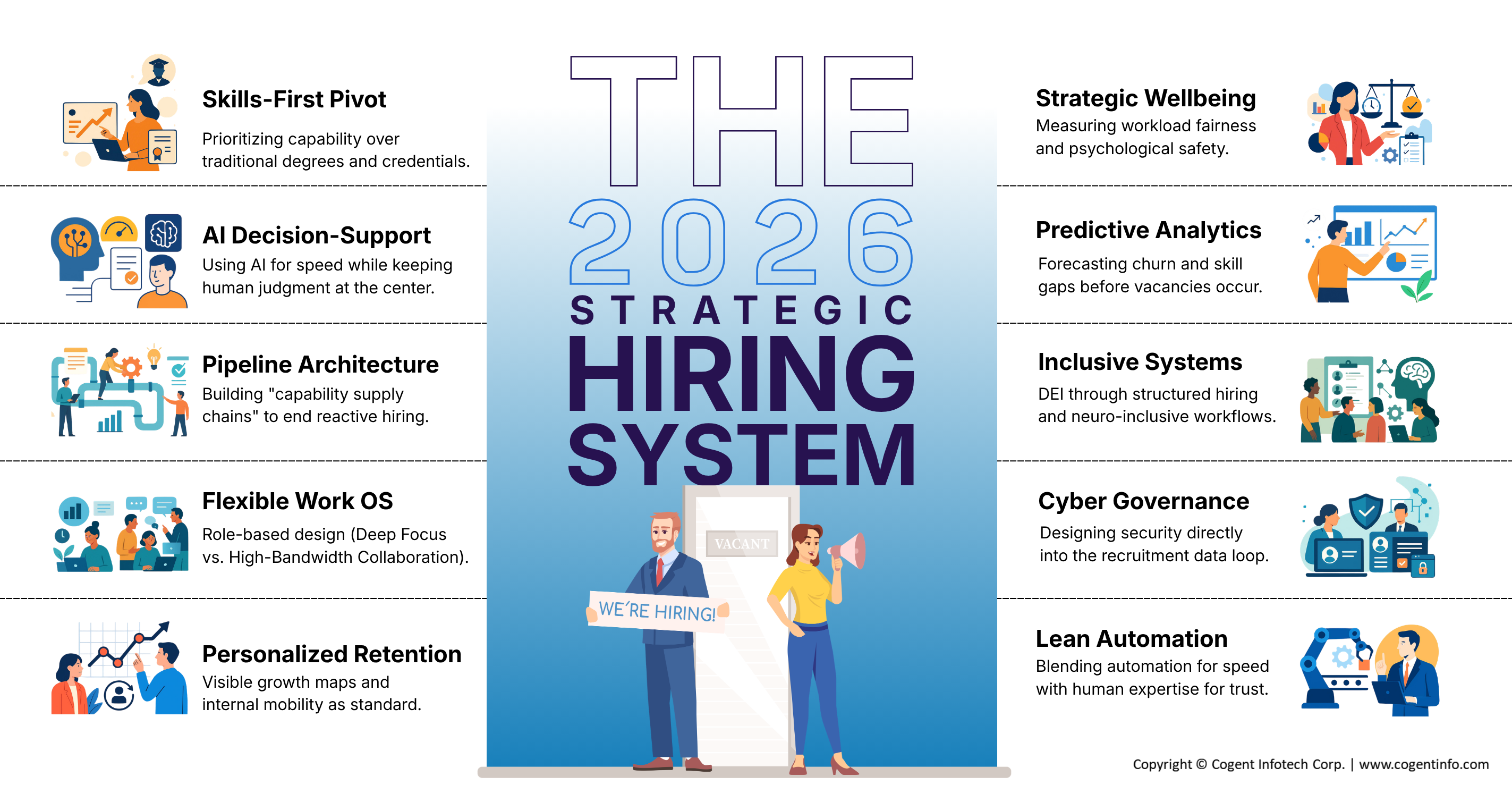
In practice, skills-based hiring requires more than removing degree requirements from job descriptions. Organisations need a clear, shared definition of what “good” looks like in each role, translated into observable behaviours and outputs. That means building a skills inventory for critical roles, linking skills to real tasks and outcomes, and updating them as the business changes. Hiring becomes more predictive when assessments mirror the work: short simulations, micro-projects, structured interviews that test reasoning, and portfolio or work-sample reviews. Done well, skills-based hiring improves quality, increases inclusion, and reduces time wasted on candidates who look good on paper but struggle in execution.
Use AI-Enhanced Talent Intelligence to Improve Decision-Making, Without Outsourcing Judgment
AI has moved from experimentation to infrastructure. In 2026, it will power large parts of the hiring workflow: sourcing, matching, screening, scheduling, candidate engagement, and increasingly, decision support. Used correctly, AI compresses cycle time and raises consistency by reducing manual noise and surfacing insights that humans would miss at scale.
The key risk is confusing automation with accuracy. AI can optimise what you measure, but it cannot define what matters, especially when context, nuance, and ethics are involved. Strong talent organisations treat AI as a decision-support layer rather than a decision-maker. That means building the capability to interpret outputs, test assumptions, validate recommendations, and override systems when they conflict with context or fairness. Predictive analytics can materially improve workforce planning by forecasting time-to-fill, turnover probability, and skills demand spikes, but only if teams operationalise governance: bias audits, transparency practices, documentation, and clear accountability for final decisions. The advantage in 2026 won’t come from “using AI.” It will come from using AI with disciplined judgment.
Build Workforce Pipelines That Reduce Dependency on Reactive Hiring
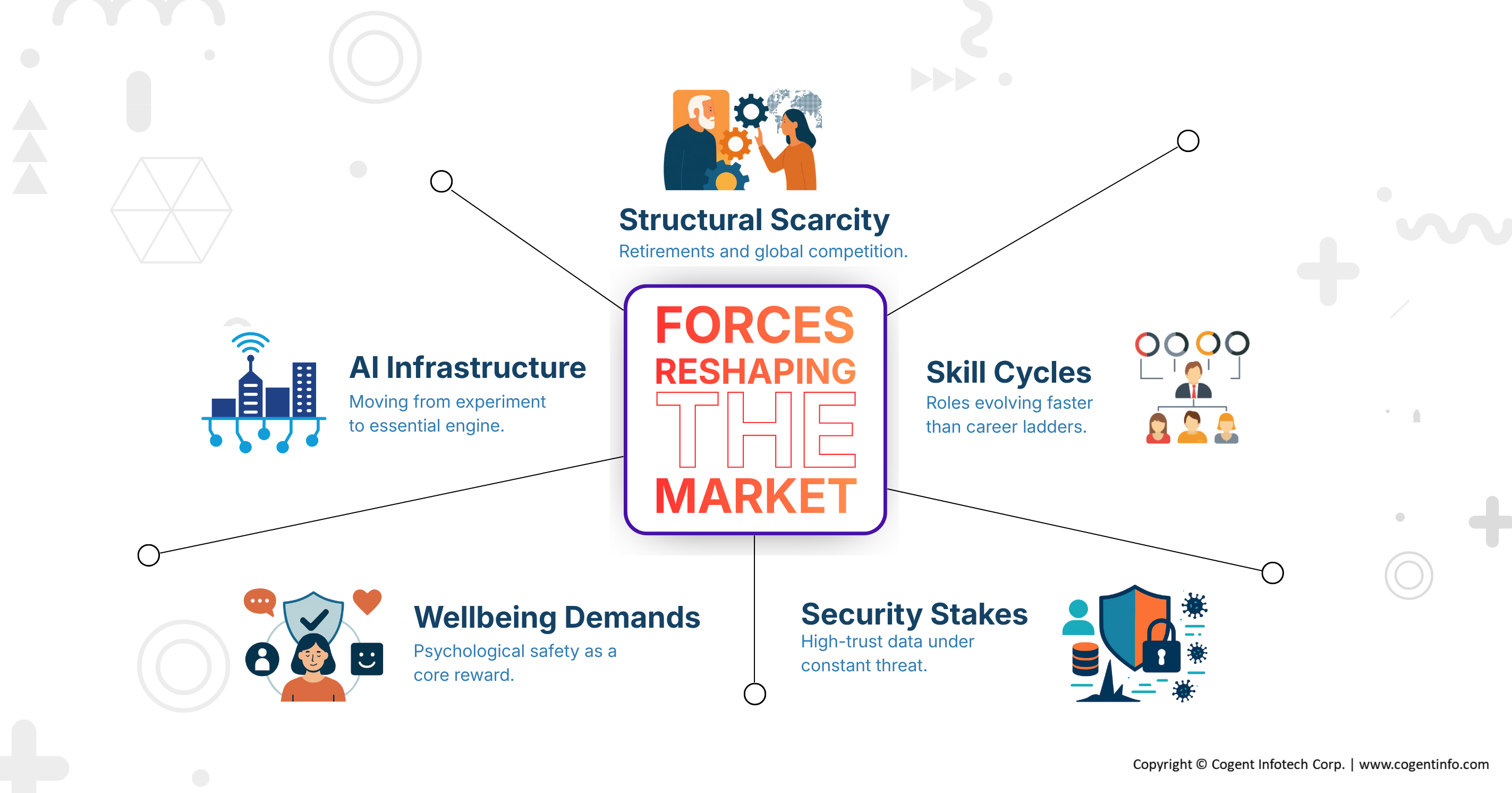
Scarcity in critical roles is no longer episodic; it’s structural. Cybersecurity, AI engineering, healthcare, education, and other high-need fields face a persistent supply-demand imbalance, accelerated by retirements, global competition, and evolving skill requirements. When scarcity becomes the norm, reactive hiring becomes a tax on growth, expensive, slow, and strategically brittle.
The winning response is pipeline architecture. Organisations need multi-tier pathways that combine external partnerships with internal development. External pipelines are strengthened by collaborating with universities, bootcamps, and certification bodies to shape curricula aligned to real roles, then converting that into consistent internships, apprenticeships, and early-career programmes. Internally, the fastest and lowest-risk pipeline is often your existing workforce. When internal mobility is treated as a system, organisations can reduce vacancy time and improve retention simultaneously by offering short-term gigs, project rotations, secondments, and clear reskilling pathways. Pipeline resilience also depends on knowledge capture: pairing experienced employees with emerging talent and codifying critical processes so expertise doesn’t leave the building. In 2026, the best hiring strategies will look less like “recruiting” and more like “capability supply chains.”
Adopt Flexible Work Models That Support Productivity Without Creating Chaos
The flexibility conversation has matured. It is no longer a simple remote-versus-onsite debate, but a design problem that includes hybrid rhythms, location flexibility, shift personalisation, and outcome-based management. Candidates increasingly view flexibility as a core part of total rewards, while employers seek to preserve collaboration, culture, and accountability. These pressures can easily create policy whiplash unless organisations adopt a clear operating model.
High-performing flexible work systems start with role clarity and task design. Teams need explicit guidance on which work requires co-location for high-bandwidth collaboration and which work benefits from remote deep focus. When flexibility is paired with output-based performance metrics, clear goals, sprint planning, role-specific KPIs, and visible progress tracking, productivity becomes easier to manage than presence. Flexible work also requires infrastructure: asynchronous tools, time-zone norms, meeting hygiene, and manager training to lead distributed teams. The final ingredient is boundary protection. Without guardrails, flexibility becomes “always on,” and burnout becomes the hidden cost. In 2026, flexible work won’t be a perk; it will be a competitive operating system.
Strengthen Talent Retention Through Personalised Growth Pathways
In 2026, retention is not separate from hiring; it is part of the same system. The cost of replacing strong talent isn’t only financial; it shows up in lost momentum, delayed delivery, weakened customer experience, and team instability. Many organisations are discovering that compensation alone doesn’t keep high performers; people stay when they can see a future, feel supported, and experience progression that matches their effort.
Retention improves when growth is structured, visible, and personalised. Organisations should define role-based growth maps that show how someone moves from entry level to advanced responsibility, including skills milestones, learning pathways, mentorship, and project opportunities that build credibility. Internal mobility is one of the most underused levers here: when teams can move across functions through rotations, internal gigs, and transparent internal hiring, employees don’t need to leave to grow. Learning programmes are most effective when embedded in work rather than sitting alongside it; micro-learning tied to real projects increases adoption and impact. And measurement matters, tracking time-to-productivity, internal fill rates, vacancy days, and learning progression turns retention from a belief into a managed outcome.
Integrate Workforce Wellbeing Into Hiring and Employer Brand
Wellbeing has become a strategic differentiator, not a “nice-to-have.” Candidates now evaluate employers on psychological safety, workload fairness, mental health support, and sustainable performance expectations, especially younger workers. When well-being is ignored, the downstream costs are predictable: absenteeism, burnout, attrition, and a damaged employer reputation that makes hiring harder and more expensive.
The most credible wellbeing strategies are measurable and behavioural, not promotional. Organisations need mechanisms to detect risk early, pulse surveys, workload data, manager check-ins, and indicators that show where pressure is building. Policy design matters too: PTO that people are truly encouraged to use, boundaries around after-hours communication, realistic staffing plans, and predictable work rhythms. Mental health support becomes more valuable when it includes manager enablement, accessible resources, and benefits that employees can actually navigate. Finally, well-being must show up in how you recruit. When hiring, content reflects genuine practices, flexibility norms, workload expectations, manager training, and growth support, you attract candidates who will thrive, not just those who will accept an offer.
Use Predictive Analytics to Plan for Demand Instead of Reacting to Vacancies
Traditional workforce planning tends to respond to vacancies. In volatile markets, that model fails because by the time a role is open, the cost of delay is already accumulating. Predictive analytics offers a different posture: anticipating churn, identifying emerging skill gaps, forecasting hiring lead times, and building bench strength before disruption hits.
To get real value from predictive planning, organisations need integrated data and operational discipline. When HRIS, ATS, performance systems, and L&D platforms are connected, leaders can see the indicators that matter: engagement shifts, flight-risk patterns, skills gaps by business unit, and time-to-productivity by role. Scenario planning then becomes actionable: modelling downturns, technology shifts, new product launches, and regional shortages, and translating them into hiring and development plans. Predictive systems aren’t “set and forget.” They require continuous calibration, testing predictions against outcomes, and updating assumptions as markets change. The organisations that win in 2026 won’t be those with the most data; they’ll be those with the best decisions built on it.
Expand DEI Through Skills, Accessibility, and Structured Hiring Systems
DEI is moving from intent to instrumentation. Many organisations still unintentionally embed bias through proxies like degrees, brand-name employers, informal referrals, and “culture fit” interviews that reward similarity. The next generation of DEI progress will come from redesigning hiring systems to fairly and consistently measure capability.
Skills-first hiring is one of the most practical DEI accelerators because it broadens access and reduces reliance on credentials that correlate with privilege rather than performance. Accessibility starts at the job description: clear language, essential outcomes, salary transparency where possible, and explicit accommodation signals. Hiring quality rises when interviews are structured and scored against defined competencies, not impressions. In some contexts, anonymised resume review and redaction tools reduce early-stage bias by focusing attention on skills. AI can support DEI by expanding sourcing and reducing manual inconsistency, but only when models are audited and paired with human oversight. True inclusion also means neuro-inclusive workflows, offering alternative interview formats and assistive tools so candidates can show their ability without unnecessary barriers.
Reinforce Cybersecurity and Data Governance Across Recruiting Workflows
Recruiting is a high-trust function handling sensitive personal data at scale: resumes, identity information, compensation details, interview notes, and background checks. As AI tools proliferate, the number of systems touching candidate data increases, expanding the risk surface. In 2026, organisations that treat recruiting security as an afterthought will face reputational risk, operational disruption, and regulatory exposure.
Security has to be designed into the workflow. That starts with encryption in transit and at rest, multi-factor authentication, and secure cloud configurations. It also requires data minimisation, collecting only what is necessary, restricting access through role-based permissions, and maintaining audit logs. Clear retention policies matter: storing candidate data indefinitely increases risk without improving hiring outcomes. When organisations use redaction for blind review, they reduce bias while also limiting exposure of personal identifiers. Finally, training is non-negotiable. Social engineering remains a primary attack vector, so recruiters and hiring managers must be equipped to recognise phishing, handle data responsibly, and follow consistent protocols.
Blend Human Expertise With Automation for Leaner, Faster Hiring
Automation will continue to compress the recruiting cycle time by removing administrative friction. Resume parsing, scheduling, reminders, compliance checks, and workflow routing can and should be automated so recruiters can focus on the work that actually requires human skill: influencing stakeholders, building relationships, assessing nuance, and protecting candidate experience.
The danger is replacing human interaction at the wrong points in the process. Candidates still need clarity, responsiveness, and respect, especially in high-stakes decisions. Over-automation can create a “cold” process that increases drop-off, increases ghosting perceptions, and damages the employer brand. The most effective approach is boundary design: automating repeatable tasks while keeping humans present in moments that shape trust, final interviews, complex evaluation, compensation discussions, and feedback. Technology should also be consolidated; fragmented tools create data silos, inconsistent experiences, and reporting blind spots. In 2026, operational excellence in TA will come from systems thinking: a lean process supported by automation, guided by humans.
Frequently Asked Questions (FAQ)
Q1: How does skills-based hiring differ from traditional recruitment?
Traditional recruitment often uses degrees, titles, and tenure as proxies for capability. Skills-based hiring evaluates demonstrable competencies through work samples, simulations, structured interviews, and portfolios. This approach aligns better with rapidly changing roles and typically expands access to strong candidates from non-traditional backgrounds.
Q2: Will AI replace recruiters?
No. AI improves speed and consistency by automating routine tasks and surfacing insights, but it cannot replace human judgment, context, relationship-building, and ethical accountability. The strongest hiring strategies in 2026 combine AI precision with human empathy and disciplined decision-making.
Q3: Why invest in wellbeing when budgets are tight?
Because well-being directly affects retention, productivity, and absenteeism. Burnout and attrition are expensive and disruptive. When well-being is designed into policies and manager behaviours, organisations reduce churn, improve performance, and strengthen employer brand, making hiring easier over time.
Q4: How can we protect candidate data when using AI in recruitment?
Protect data through encryption, access control, audit logs, data minimisation, and defined retention policies. Vet vendors carefully, document how data is processed, and train teams to prevent phishing and social engineering. Where useful, redaction can support both privacy and fair screening.
Q5: What can small and mid-sized businesses do to build talent pipelines?
SMBs can start with scalable moves: partnerships with local colleges and bootcamps, internships or apprenticeships, structured mentorship, internal mobility, and focused upskilling tied to real business needs. Smaller organisations often have an agility advantage, piloting and iterating faster than large enterprises.
If you’re rethinking your hiring strategy for 2026, don’t leave it to trial-and-error.
Cogent Infotech helps organisations build future-ready talent systems, skills-based hiring frameworks, AI-enabled recruiting workflows, predictive workforce planning, and scalable pipelines for hard-to-fill roles, without losing the human touch that protects candidate experience and retention.
Whether you’re hiring at scale, struggling with niche talent scarcity, or modernising your TA stack, we’ll help you move faster with a strategy that actually holds up in real-world conditions.
Connect with Cogent Infotech to discuss your 2026 workforce plan and get a tailored roadmap for smarter, leaner hiring.