


Micropersonalization: The Next Generation of Apps That Know You Before You Click


The digital experience we’ve grown used to is shifting, quietly but profoundly. For years, apps and platforms have relied on personalization: showing you things you already like, based on your past actions. But today, that is no longer enough. What’s emerging is micropersonalization: systems that anticipate what you will need next even before you consciously realize it.
Imagine your fitness app spotting that you’re on the cusp of training for a marathon, based on subtle signals like recent browsing, upcoming calendar entries, and gear purchases. Or your food-delivery app nudging you at exactly 6:47 pm on a Thursday, because it has learned that this is when you get most tired after work and are highly likely to crave dinner without wanting to cook. That’s not simply “putting your past behaviour into a recommendation” but anticipating your future behaviour.
Let’s dive into what micropersonalization is, how it’s built, where it’s already being used, what’s coming next, and the implications, both exciting and cautionary.
Understanding Micropersonalization: Beyond Traditional Customization
What does “traditional personalization” look like?
- If you’ve bought a mystery novel, the app suggests more mystery novels.
- If you watched action movies, your streaming service recommends more action titles.
- These systems are reactive: you act first, then the system responds.
- The approach is primarily based on one dimension: you did X, so we’ll provide you with more things like X.

What is micropersonalization, and how does it differ from personalization?
Micropersonalization is a step change in how we think about personalization:
- Instead of responding only to what you did, it attempts to understand what you will need next.
- It draws on a rich variety of data, not just your past purchases or clicks, but when you do them, where you are, what device you use, your mood (inferred), environmental context, and what similar users have done.
- Rather than saying “you liked X so we’ll show Y”, it asks: “Given your current context, your past patterns, the environment and people like you, what do you need next?”
- It shifts the user from making explicit choices to being supported by a system that feels like a personal assistant: “I thought you might need this, shall I set it up for you?”
Key differences summarized
- Reactive vs. anticipatory: Traditional takes you as you were. Micropersonalization tries to take you where you are going.
- Single dimension vs. multidimensional context: Instead of only using past behaviour, micropersonalization uses time of day, location, calendar events, device usage, weather conditions, and more.
- User in control vs. user-assisted: Traditional systems provide suggestions; micropersonalization models anticipate the next move and prompt you.
The Technology Powering the Predictive Revolution
Several technological threads have converged to make micropersonalization feasible at scale.
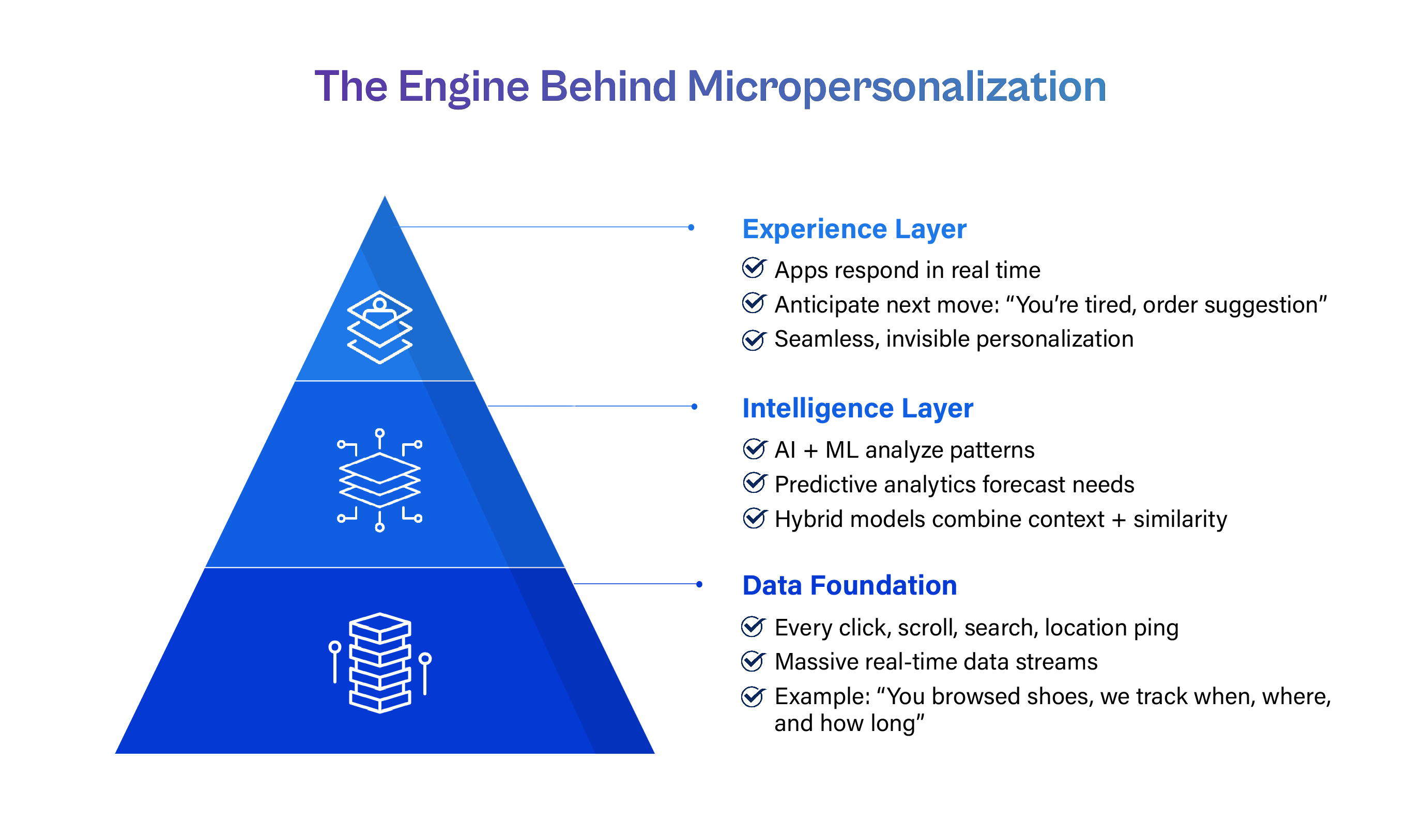
Artificial Intelligence & Machine Learning
- Beneath the surface, deep learning models are analysing mountains of data to identify patterns that human insight alone couldn’t surface.
- These systems look across multiple dimensions: time-of-day patterns, device types, hover durations, click abandonment points, location and movement, and social signals, providing textured data far richer than simple “you liked X”.
- Classic techniques, such as collaborative filtering (what people like you have done) and content-based filtering (what items have similar attributes), are still being used but now they are combined with hybrid approaches and enriched with context.
- In other words, the system doesn’t just know what you watched or bought, it predicts what you’re likely to want next, based on sophisticated modelling of behaviour and environment.
Big Data & Predictive Analytics
- For micropersonalization to work, you need data: lots of it, and fast. Every session, click, scroll, hover, abandonment, search query, device type, and network condition becomes a data point.
- The market for AI-based personalization is already massive: for example, one estimate places the global “AI-based personalization engines” market at around USD 455 billion in 2024, projected toward USD 717 billion by 2033. Grand View Research
- Another forecast sees the AI-based personalization market growing from around USD 498 billion in 2023 toward roughly USD 788 billion by 2033 at a ~4.7 % CAGR. Market.us
- These numbers underscore that micropersonalization is not a fringe concept, it’s rapidly becoming foundational to the digital experience.
Real-Time Contextual Processing
- The most important enabler is the ability to capture and process context in real time. It’s not enough to know someone has watched lots of comedies; you also need to know they’re currently commuting, their time zone has changed, their device battery is low, traffic is heavy, and rain is forecast.
- An example: Google Maps doesn’t simply show you a route, but it also predicts when you should leave based on historical traffic, your personal habitual departure times, and current conditions.
- The system anticipates: “You usually leave at 8 am, traffic is heavier today, you should leave at 7:45 instead.” That’s an early version of anticipatory service.
Current Applications: Micropersonalization in Action
Micropersonalization isn’t theoretical. It’s already in motion across many sectors, some obvious, some more subtle.
Anticipatory Food & Delivery Services
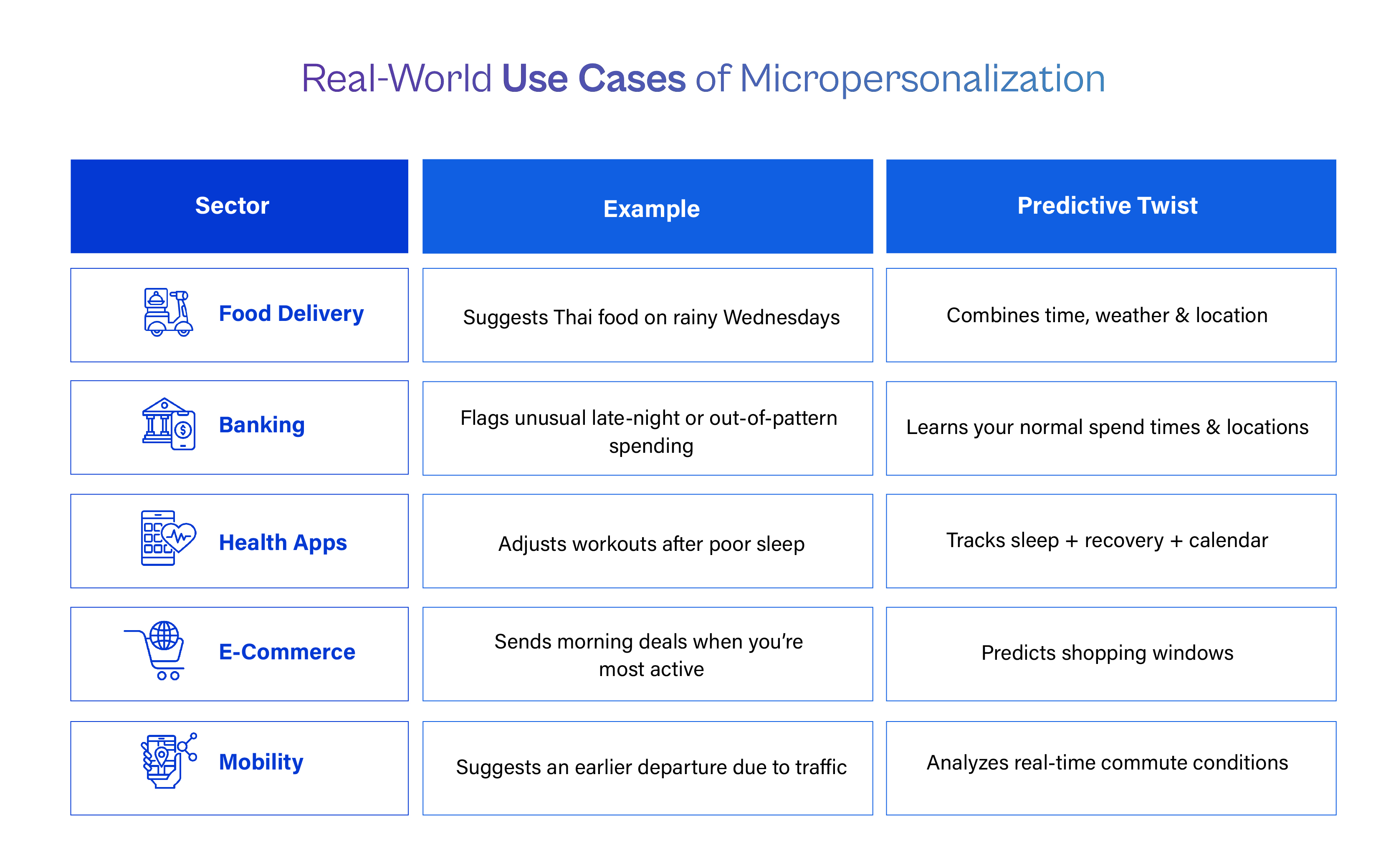
- Food-delivery apps now look beyond “you ordered pizza last week” and move toward “you tend to order Thai food on rainy Wednesday evenings when you’re at home”.
- They combine location, time-of-day patterns, weather, and event calendars (such as a movie release, which may prompt you to order later), and produce a proactive offer: “It’s 7 pm, rain just started, home location detected -> how about Thai food menu tonight?”
- This works because the system has learned micro-patterns: not just what you order, but when, where, under which conditions, with which companions.
Health & Wellness Prediction
- Fitness and wearable-device apps are also using micropersonalization. Rather than generic workout plans, they analyze your historical exercise data, recovery patterns, sleep quality (via heart rate variability), upcoming calendar commitments, and local weather to suggest optimal times and intensities.
- For example, the system might notice you had disrupted sleep last night, your calendar shows a lighter day tomorrow, and the weather is good, so it suggests a moderate midday run rather than a heavy training session.
- In some high-end applications, deep neural networks analysing continuous body temperature data have been used to predict labor onset in expectant mothers, a vivid example of anticipatory health prediction.
Intelligent Mobility & Transportation
- Transportation apps have matured into intelligent mobility assistants. They learn your regular route, your usual departure time, your preferred mode of transportation, and your tolerance for traffic.
- Then, when there’s an event, a weather change, or a transit disruption, they proactively suggest: “Leave 10 minutes earlier,” or “Switch from train to bus because of delay,” or “Rideshare may be faster today given heavy rain.”
- This kind of service moves from “tell me where to go” to “tell me when and how to leave”.
Financial Services & Predictive Banking
- Financial services apps are adopting micro-personalization to enhance user experience and economic health. They monitor your spending patterns, upcoming bill due dates, income schedules, and savings goals.
- Based on that data, they can suggest actions: “Your electricity bill is due in 3 days and your checking balance is low, shall I transfer X amount from savings?” or “You usually spend more on entertainment this weekend, consider increasing your emergency fund contribution this month.”
- One case-study site describes how banks are using dynamic micro-personalization to drive customer engagement and loyalty. SuperAGI
Retail & E-Commerce Intelligence
- In retail, micropersonalization extends beyond “you looked at this item, so here’s a discount.” It’s “you’ve browsed research on product X for the last two evenings, you’re running low on product Y, and your shipping location suggests you’ll need delivery by Saturday, so here’s a timed offer right now”.
- Research shows that dynamic content adaptation is becoming an increasingly dominant portion of personalization budgets.
- For example, retailers are using machine-learning models to track not just clicks, but hesitations, abandonment, and browsing rhythms, and then proactively engage before the user has made a decision.
The Path to 2026: What’s Coming Next
Looking ahead, the next 18–24 months promise to accelerate what micropersonalization can deliver.
Truly Predictive, Context-Aware Applications
- By 2026, applications are expected to become even more anticipatory and almost “telepathic” in feel.
- Consider a productivity app that knows you have a major presentation in three days. It examines how you’ve prepared for similar past events, analyzes the audience profile (maybe via CRM or calendar invite data), predicts likely questions, scours your files and bookmarks to assemble relevant reading material, monitors your schedule and energy patterns, and suggests the optimal time slot to rehearse and even blocks it for you.
- This kind of depth of assistance moves micropersonalization from suggestion to assistive orchestration.
Invisible User Interfaces
- The interface will fade into the background. You won’t have to drill down through menus and options, you’ll open the app and it will already know what you likely need.
- Analysts suggest that most customer-service interactions will soon be handled not by people, but by predictive AI systems that detect issues before customers are aware of them. That same model will carry into day-to-day apps: invisible assistants that manage the routine and let you focus on the exception.
Adoption Forecasts & Market Trajectories
- Micropersonalization will cease to be a differentiator and instead become a baseline. By 2026, most e-commerce and service businesses will need AI-powered personalization to stay competitive.
- For example, a forecast places the AI-based personalization market globally at roughly USD 498 billion in 2023, rising toward USD 788 billion by 2033. Market.us
- A different source estimates approximately USD 455 billion in 2024, rising to USD 717 billion by 2033. Grand View Research
- Regions to watch: North America remains dominant, while the Asia-Pacific region is experiencing rapid growth due to increased digital transformation and e-commerce penetration.
The Benefits: Why Micropersonalization Matters
Let’s take a closer look at why micropersonalization isn’t just tech hype, the advantages are real.
Efficiency & Convenience
- When apps anticipate your needs, you spend less time searching, browsing, and deciding. The friction of digital interactions goes down.
- If a system can save even just three minutes per day across multiple apps, that adds up to ~18 hours per year of saved time. That’s meaningful.
- For busy users (professionals, parents, multi-taskers), those small savings compound into quality time regained.
Improved User Experience
- Consumers are increasingly preferring companies that tailor their experiences to them. In emerging markets, especially, the appetite for personalized digital services is strong.
- When your digital environment “just knows you,” the experience feels seamless, frictionless, and even delightful.
Competitive Advantage for Businesses
- In markets where products become commoditized, experience becomes the differentiator.
- Companies implementing effective micropersonalization report conversion lifts of 20–30% compared to more generic personalization.
- Offering the right product at the right time, in the proper context, builds stickiness: the user doesn’t just browse; they act, and often sooner.
The Challenges: Legitimate Hurdles to Navigate
However, every upside carries a flip side. Micropersonalization raises real concerns that must be addressed.
Privacy & Data Collection Concerns
- The very nature of micropersonalization is that it collects and uses more intimate data. Location, behavioural rhythms, mood, device usage, these are deeper than “you bought item X”.
- Many consumers feel uneasy, as they’re unsure how their data is used, don’t understand the logic behind predictions, and worry about surveillance.
- There’s a transparency gap: a large portion of consumers report low understanding of how companies leverage their data, which undermines trust.
Algorithmic Bias & Fairness
- If your model is trained on biased data, predictions will reflect and amplify those biases.
- In hiring algorithms, we have seen specific demographics systematically underserved. In micropersonalization, similar risks exist: certain user groups may receive more favorable predictive experiences, while others may receive less favorable ones.
- Ensuring fairness involves auditing models, continuously monitoring outcomes, and being prepared to correct any bias.
Over-Automation & Loss of User Autonomy
- There’s a risk that users feel their agency is eroded, that if an app always chooses for you, how much control do you retain?
- The line between helpful nudging and manipulative forcing can be thin. If you’re constantly being steered, you may feel less like a user and more like a passenger.
- Effective systems will offer transparency: why did the algorithm suggest this? And how can you override or correct it?
Business & Design Implications
If you are building, deploying, or using micropersonalization in business, what should you consider?
Privacy by Design
- Start at the architecture level: collect only the data you need, anonymize where possible, secure by default.
- Consider techniques such as federated learning (where models learn across devices without centralizing raw data) or differential privacy (which introduces “noise” to protect individual identities) to strike a balance between personalization and privacy.
- Make privacy a feature, not a constraint. When companies genuinely design with privacy in mind, they earn trust.
Transparent Data Practices
- Don’t hide behind long boilerplate terms of service. Explain at the point of data collection what is being collected, why, and how it will be used for predictions.
- Offer dashboards or simple views where users can see what the system “knows”, why it predicted something, and how they can correct it.
- Transparency fosters trust, which is foundational in predictive systems.
User Control & Consent
- Provide granular data-sharing options: users should be able to choose what to share, which predictive features to engage with, and what to disable.
- Opt-in rather than default opt-out builds better engagement.
- Allow users to edit, correct, or delete their data and to override system suggestions.
- Remember: automation should assist decision-making, not replace it.
Balancing Personalization & Privacy
- Interestingly, research suggests that companies that prioritize privacy can build stronger customer relationships than those that prioritize maximal data collection.
- The narrative: personalization and privacy are not mutually exclusive if handled thoughtfully. One can drive the other.
- Approach personalization as a trust-building service, not as hidden surveillance.
Regulatory Landscape: What You Should Know
Any serious micropersonalization strategy must be built with regulatory compliance in mind.
General Data Protection Regulation (GDPR) & European Landscape
- Under the GDPR, individuals have the right not to be subject to decisions based solely on automated processing if those decisions have legal or similarly significant effects.
- Organisations must provide meaningful information about the logic behind automated choices (the “right to explanation”).
- The EU Artificial Intelligence Act (effective 2024) provides a risk-based framework for AI governance: systems deemed high-risk must meet transparency, bias detection, and human oversight requirements.
California Consumer Privacy Act (CCPA) & U.S. Regulation
- In regions like California, consumers have the right to understand what data is collected about them, to opt out of data sales, and to request the deletion of their data.
- Proposed rules also address systems that analyse personal data to predict behaviour, job performance, or preferences.
Enforcement & Penalties
- Privacy and AI governance enforcement has shifted from warnings to severe penalties: companies have faced millions of dollars in fines for non-compliance, signaling that regulatory risk is real.
- For businesses deploying micropersonalization, ignoring regulation is not an option, compliance is part of the business case.
Case Examples & Industry Snapshots
Let’s zoom in on specific industry examples to ground how micropersonalization plays out in real settings.
Retail / E-Commerce Example
- A user might repeatedly browse running shoes in the evening, then associate the device type “mobile” with a quick purchase intent.
- The system infers: “You will likely buy shoes tomorrow morning, let’s send a targeted offer at 8 am with free shipping because you typically purchase then.”
- Retailers report that dynamic content (e.g., timing offers when predicted need is high) now forms a large part of their personalization budget.
Banking & Financial Services Example
- A bank tracks spending cycles: rent is deducted on the 1st of the month, bills are deducted on the 10th, and income is credited on the 3rd. It sees the user’s savings drop below the threshold near the 25th.
- The system signals: “User may be short of funds before payday, trigger nudges to reduce non-essential spending and optionally pre-transfer funds from an interest-bearing account.”
- This type of predictive financial assistance helps users avoid overdraft fees, improves retention, and fosters trust.
Health & Wellness Example
- A wearable device records poor sleep quality for four nights. Heart-rate variability is trending down. The calendar indicates three consecutive meetings scheduled for tomorrow morning. The weather forecast indicates high humidity.
- The system prompts: “Consider a lighter workout tomorrow morning, perhaps yoga instead of HIIT, and move your morning meeting start to 10 am so you can recover.”
- By predicting the user’s readiness, not just prescribing generic advice, the app becomes more intelligent and supportive.
The Path Forward: Balancing Convenience and Autonomy
As micropersonalization evolves, we reach a pivotal juncture: how do we capture the promise without sacrificing user agency or trust?
The Promise
- When done well, micropersonalization reduces decision fatigue, saves time, and makes digital life smoother and more intuitive.
- For users, that means fewer “Which option should I pick?” moments and more “Here’s exactly what I need, and done”.
- For businesses, this means deeper relationships, higher conversion rates, stronger differentiation, and operational efficiency.
The Human Element
- It’s important to remember that technology should augment human decision-making, not replace it.
- The best micropersonalization feels like having a thoughtful assistant: it knows your patterns, supports your goals, anticipates your needs, but always gives you the choice.
- If the system becomes its own dictator (“Here’s what you will do now”), then you risk resistance, lack of trust, and disengagement.
Conclusion
Micropersonalization promises to make digital experiences smarter, faster, and far more useful by anticipating needs rather than merely reacting to past behavior. Its benefits, greater efficiency, better user experiences, and stronger business differentiation are real, but they come with real risks: privacy erosion, algorithmic bias, and loss of user autonomy. Successful adoption depends on design choices: privacy-by-design, transparent data practices, clear user controls, and robust governance. Built with those guardrails, micropersonalization can become a trusted, invisible assistant that saves time, reduces friction, and amplifies human choice.
Ready to build digital experiences that predict customer needs, not just respond to them?
Connect with Cogent Infotech to explore how AI-driven micropersonalization can improve engagement, conversion, and customer loyalty, without compromising privacy.
Let’s talk.
Real-World Journeys
.jpg)

.jpg)
.jpg)

