


Deepfake Onslaught: Why 2026 Will Demand Enterprise-Grade Defense Now



Introduction
By 2026, enterprises will be facing a new kind of cyber risk that doesn’t break into systems but undermines trust. Deepfakes, once seen as internet curiosities, are quickly becoming a serious business problem. With tools that can generate convincing video, voice, and even gestures at little to no cost, attackers can impersonate executives, employees, or vendors with startling accuracy. Incidents like the $25M Hong Kong CFO fraud and FBI warnings about voice‑cloning scams show how quickly this threat is moving from theory to reality.
The challenge is that most organizations are not ready. Security teams still focus on passwords and firewalls, while few have protocols for verifying identities or authenticating media. Employees often have not been trained to spot AI‑driven impersonation attempts, and response playbooks are rare. This article makes the case that deepfake defense is the next frontier in cybersecurity. We will explore why the threat is escalating, the real consequences already unfolding, the types of attacks enterprises must anticipate, and most importantly, outline a practical Enterprise Deepfake Defense Playbook to help organizations protect their integrity in 2026 and beyond.
Why Deepfakes Explode as a Top Enterprise Threat in 2026
The year 2026 marks a tipping point for deepfake technology. What was once experimental or niche is now mainstream, accessible, and alarmingly effective. Several forces are converging to make synthetic impersonation the most pressing enterprise risk of the year.
Hyper‑realistic multimodal generation
Deepfake tools have advanced far beyond simple face swaps. Today, they can replicate not only facial features but also voice, tone, gestures, and even subtle mannerisms. This means an attacker can convincingly mimic a CEO in a video call or reproduce an employee’s voice in a phone conversation. For enterprises, the challenge is that these outputs are nearly indistinguishable from authentic communication.
Zero‑cost production and unlimited distribution
Creating a convincing deepfake no longer requires expensive hardware or specialized expertise. Free or low‑cost platforms allow anyone to generate synthetic media in minutes. Once produced, these files can be distributed instantly across email, messaging apps, or video conferencing platforms. The barrier to entry is gone, and the scale of potential attacks is unprecedented.
Deepfake‑as‑a‑service marketplaces
A growing underground economy now offers deepfake creation as a service. Attackers can purchase ready‑made impersonations or commission custom videos and audio clips. This commoditization means that even individuals with no technical skills can launch sophisticated impersonation attacks against enterprises. The availability of these services mirrors the rise of ransomware‑as‑a‑service, which transformed cybercrime into a scalable business model.
Rising corporate impersonation
The threat is not theoretical. Enterprises are already reporting incidents of executive voice scams and fraudulent video calls. Attackers use deepfakes to authorize wire transfers, approve contracts, or manipulate negotiations. Each successful impersonation erodes trust within organizations and exposes them to financial and reputational damage. By 2026, these attacks are expected to surge as tools become more refined and attackers more organized.
How Deepfakes Damage Trust and Finances
The impact of deepfake attacks is no longer hypothetical. Enterprises are already facing financial losses, reputational crises, and regulatory investigations tied to synthetic impersonation. Fraudsters use convincing audio and video to mimic executives, employees, and partners, exploiting trust in ways traditional cyberattacks cannot. A single deepfake call can authorize transfers, spread false announcements, or manipulate investor sentiment, creating ripple effects that damage both finances and credibility.
These incidents are early warnings of what will become routine by 2026. As deepfake technology becomes cheaper and more accessible, attackers can scale impersonation campaigns with minimal effort. Enterprises must recognize that trust itself is now a primary vulnerability, and defending against deepfakes is a core pillar of resilience.
Financial losses from executive impersonation
In Hong Kong in 2024, attackers used a deepfake video call to impersonate a company’s CFO. Employees believed they were speaking to their leader and authorized transfers totaling $25 million. What makes this case alarming is that the fraud bypassed traditional cybersecurity defenses entirely. The attackers didn’t need to hack systems or steal credentials, they simply exploited trust in human communication. Analysts expect similar incidents to multiply as deepfake tools become more accessible, with potential losses running into billions globally.
Rising voice‑clone scams in the United States
The FBI has warned of a surge in voice‑cloning attacks targeting enterprises. Criminals replicate the voices of executives or family members to pressure employees into urgent actions, such as wiring funds or sharing sensitive information. These scams are spreading rapidly because cloning requires only a few seconds of audio, often scraped from public speeches, interviews, or social media. Enterprises are reporting spikes in business email compromise cases where voice cloning is combined with phishing, creating multi‑layered attacks that are harder to detect.
Regulatory and legal consequences
Governments are beginning to respond. The European Union’s AI Act requires synthetic media to be labeled, and regulators are considering stricter disclosure rules for enterprises that fall victim to deepfake incidents. In the U.S., the SEC has raised concerns about market manipulation through fake announcements, while the FTC is exploring consumer protection measures. Enterprises that fail to implement safeguards may face fines, lawsuits, or reputational damage if regulators determine negligence in handling synthetic impersonation risks.
Reputational damage and erosion of trust
Deepfakes can undermine confidence in leadership and destabilize internal culture. A fabricated video of a CEO announcing layoffs or a fake HR message about policy changes can spread quickly inside an organization. Even if debunked, the initial shock can damage morale and weaken trust in official communications. For enterprises, reputation is as valuable as capital, and deepfakes threaten both. Once trust is shaken, rebuilding it requires significant time, transparency, and investment.
Operational disruption
Deepfake incidents can paralyze decision‑making. If employees are unsure whether a communication is authentic, they may delay approvals, halt transactions, or escalate verification processes. This slows down operations and creates friction across teams, especially in high‑stakes environments like finance, procurement, or supply chain management. In industries where speed is critical, such as logistics or trading, even short delays can translate into significant losses.
Investor and market impact
A convincing deepfake announcement about earnings, mergers, or leadership changes can trigger stock volatility within minutes. Automated trading systems that react to news headlines are particularly vulnerable, amplifying the impact of false information. Even if corrected, the initial shock can erode investor confidence and damage long‑term credibility. Analysts warn that deepfakes could become a new vector for financial market manipulation, forcing enterprises to adopt rapid verification protocols for public communications.
Customer trust and brand perception
Customers expect clear, reliable communication from the companies they engage with. A deepfake incident that spreads misinformation about product recalls, pricing changes, or service disruptions can quickly erode brand loyalty. In consumer-facing industries like retail, travel, or healthcare, misinformation can cause panic or confusion, leading to lost revenue and reputational harm. Enterprises must recognize that synthetic media can damage customer relationships as easily as it can disrupt internal operations.
Types of Enterprise Deepfake Attacks
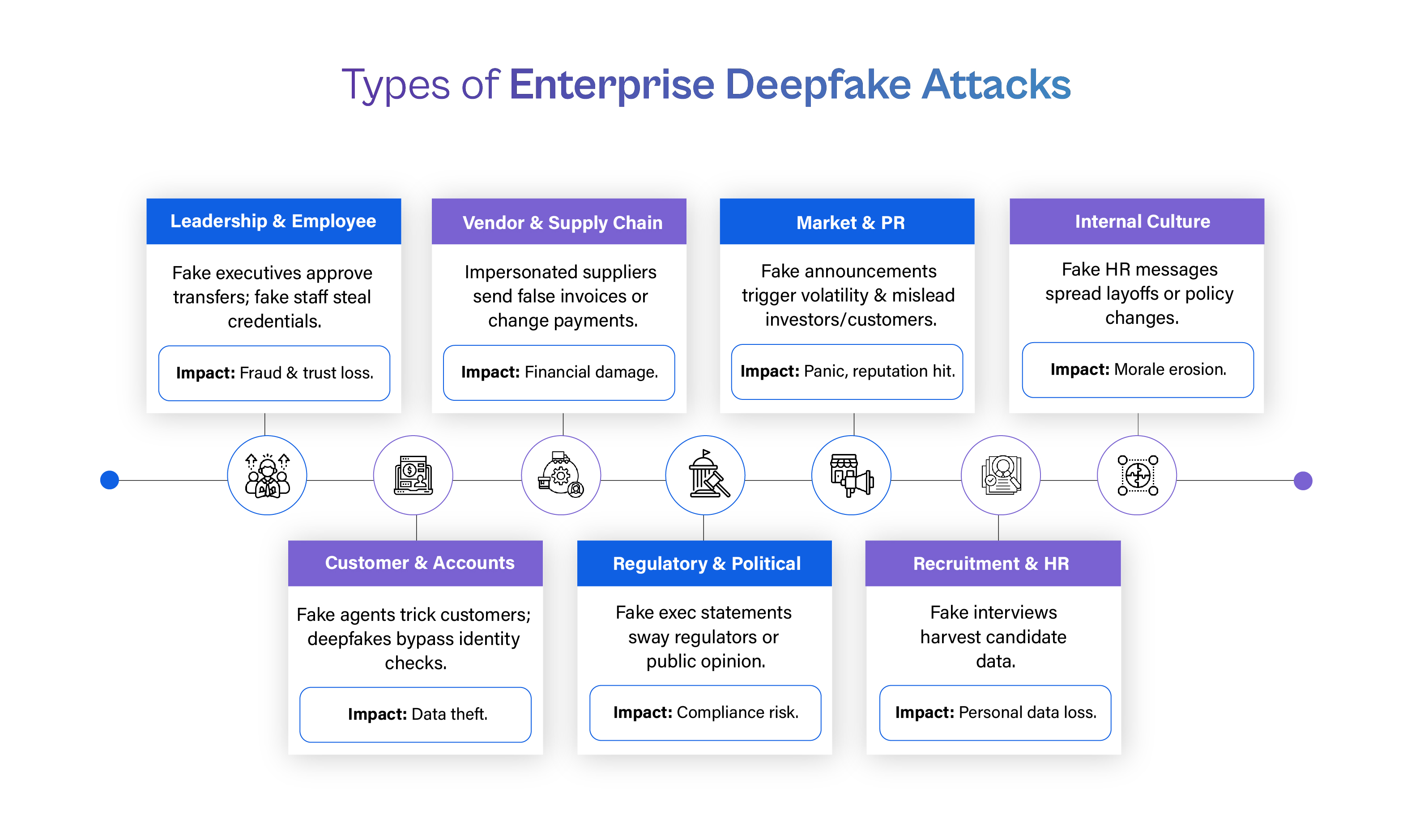
Deepfake technology has evolved into a powerful tool for attackers, enabling convincing impersonations of executives, employees, vendors, and even regulators. These synthetic audio and video threats bypass traditional defenses and exploit trust in ways enterprises are unprepared for. Each attack type undermines confidence differently, from authorizing fraudulent transactions to spreading false announcements or destabilizing internal morale. Together, they create a broad spectrum of risks that organizations must anticipate and address to protect finances, reputation, and resilience.
Executive impersonation
Attackers mimic CEOs, CFOs, or other senior leaders to authorize wire transfers, approve contracts, or push through sensitive decisions. A convincing video call or audio clip can override normal caution, especially when employees feel pressure to act quickly. These attacks exploit hierarchical trust, where employees are conditioned to follow executive instructions without hesitation. The Hong Kong CFO case is a clear example of how devastating this vector can be.
Employee impersonation
Deepfakes can be used to impersonate colleagues in order to harvest credentials or spread malware. For example, a fake video message from an IT administrator might instruct staff to reset passwords using a malicious link. Because the impersonation appears internal, employees are more likely to comply. This vector turns everyday collaboration tools into attack surfaces, making internal communication channels a new frontier for cyber risk.
Supply chain and vendor impersonation
Enterprises rely heavily on external vendors and partners. Attackers can impersonate suppliers to send fraudulent invoices, alter payment details, or manipulate procurement processes. A deepfake video or audio message from a “vendor representative” can bypass standard checks, especially in fast‑moving supply chains where speed is prioritized over verification. This type of attack can ripple across multiple organizations, magnifying the damage.
Market manipulation
Synthetic media can be weaponized to influence financial markets. A fake announcement about earnings, mergers, or leadership changes can spread rapidly, triggering stock volatility and investor panic. Automated trading systems that react to headlines are especially vulnerable, amplifying the impact of false information. Even if corrected, the reputational damage can linger, making this vector a serious concern for publicly traded companies.
Internal morale attacks
Deepfakes can destabilize organizations from within. A fabricated HR message announcing layoffs, benefit cuts, or policy changes can spread quickly among employees, creating confusion and anxiety. Even after clarification, the incident can erode trust in official communications and weaken morale. These attacks exploit the emotional core of enterprise culture, making them uniquely damaging.
Customer service impersonation
Attackers use cloned voices or fake video avatars to pose as call‑center agents, tricking customers into sharing account details or authorizing fraudulent transactions. Banks and telecoms are already reporting surges in deepfake calls targeting customer accounts. This vector damages both customer trust and enterprise reputation, as victims often blame the company for failing to protect them.
Account hijacking via social engineering
Deepfakes are combined with phishing campaigns to bypass identity checks. For example, a fake video of an employee requesting password resets can convince IT teams to grant access. Unlike traditional phishing emails, deepfake video or audio adds credibility, making employees more likely to comply. This hybrid attack blends synthetic media with classic social engineering tactics.
Political or regulatory manipulation
Synthetic media can be used to spread false statements attributed to executives or companies, influencing regulators, policymakers, or public opinion. A fabricated video of a CEO criticizing government policy or announcing compliance failures could trigger investigations or damage relationships with regulators. This vector extends the risk beyond enterprise operations into the public and political sphere.
Recruitment and HR fraud
Fake job interviews or onboarding sessions conducted with deepfake personas can harvest personal data from candidates or new hires. As enterprises digitize hiring processes, attackers can exploit video platforms to impersonate recruiters or HR staff. This not only compromises personal data but also damages employer brand reputation.
Public relations sabotage
A fabricated press conference or product announcement can damage brand reputation, confuse customers, and mislead investors. These attacks exploit the speed at which news spreads across social media and traditional outlets. Even if quickly debunked, the initial shock can undermine confidence in the enterprise’s communications.
Why Companies Aren’t Ready
Despite rising awareness of deepfake threats, most enterprises remain underprepared. Synthetic media has advanced faster than defenses, creating a gap between attacker sophistication and organizational readiness. Traditional cybersecurity tools stop system intrusions but cannot detect impersonations of people, leaving enterprises vulnerable.
Few companies have protocols to verify video calls or audio messages, and detection tools are rarely deployed. Employee training seldom covers synthetic impersonation, and incident response playbooks are missing. Regulatory uncertainty further delays investment, allowing attackers to exploit weak defenses. In 2026, readiness against deepfakes will define resilience, yet many organizations still treat the threat as tomorrow’s problem.
Overreliance on traditional security
Most security teams still focus on firewalls, passwords, and endpoint protection. These tools are designed to stop intrusions into systems, not impersonations of people. Deepfakes bypass technical defenses by exploiting human trust, which means traditional cybersecurity investments alone are insufficient. Without identity safeguards, enterprises remain exposed to manipulation, fraud, reputational crises, and regulatory penalties that traditional defenses cannot anticipate or prevent effectively.
Lack of identity verification protocols
Few enterprises have processes for verifying the authenticity of video calls, audio messages, or digital communications. Employees often assume that if a message comes through official channels, it must be legitimate. Without verification steps, attackers can exploit this blind spot with ease. Enterprises need layered identity checks, multi‑factor validation, and authentication workflows to ensure synthetic impersonations are detected before trust is exploited and damage occurs.
Limited employee awareness
Training programs typically cover phishing emails and malware but rarely address synthetic impersonation. Employees are not taught how to spot subtle inconsistencies in voice, video, or gestures. This lack of awareness makes staff the weakest link in defending against deepfakes. Without awareness programs, employees cannot challenge suspicious requests, leaving enterprises vulnerable to fraud, reputational harm, and regulatory exposure from preventable synthetic impersonation incidents.
Absence of incident response playbooks
When a suspected deepfake incident occurs, most organizations have no clear protocol for escalation, investigation, or communication. Without a playbook, responses are slow, inconsistent, and often reactive. This delay increases the damage and undermines confidence in leadership. Enterprises must design structured playbooks with escalation paths, forensic tools, and communication strategies to contain synthetic impersonation quickly and reassure stakeholders during crises.
Regulatory uncertainty
Enterprises are unsure how regulators will treat deepfake incidents. Will they be considered fraud, negligence, or a failure of cybersecurity governance? This uncertainty discourages proactive investment and leaves organizations vulnerable to fines or reputational fallout when incidents occur. Without clarity, enterprises hesitate to invest in detection, governance, or training, creating systemic risk that regulators may later penalize with severe consequences.
Technology gaps
While detection tools are emerging, they are not yet widely deployed across enterprises. Many organizations lack access to AI‑driven authentication systems that can analyze video and audio for synthetic artifacts. As a result, attackers often face little resistance when deploying deepfakes. Enterprises must invest in scalable detection platforms, integrate them into workflows, and ensure synthetic impersonation risks are addressed before attackers exploit vulnerabilities.
The Enterprise Deepfake Defense Playbook
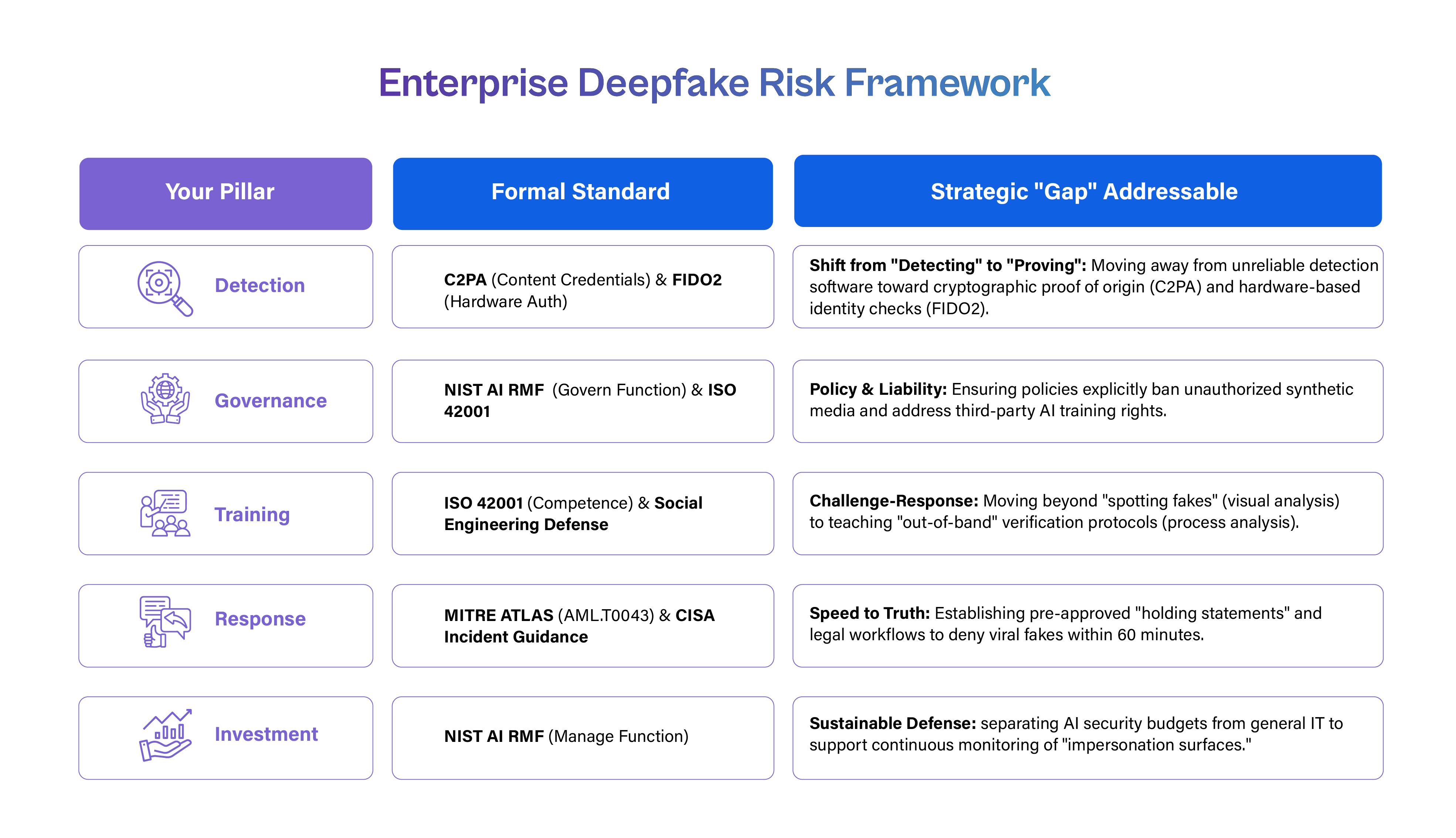
Enterprises cannot afford to treat deepfakes as a distant or niche risk. By 2026, synthetic impersonation will be a mainstream attack vector, and organizations need a structured defense framework. The playbook below outlines the essential pillars of protection: detection, governance, training, and response.
Detection and authentication tools
- AI‑driven detection systems: Deploy solutions that analyze video, audio, and images for synthetic artifacts. These tools can flag inconsistencies in facial movements, voice modulation, or pixel patterns.
- Multi‑factor identity verification: Require secondary confirmation for sensitive requests, such as financial transfers or contract approvals. This can include secure messaging, biometric checks, or independent callbacks.
- Media watermarking and provenance tracking: Adopt technologies that embed invisible markers in authentic communications, making it easier to distinguish genuine content from manipulated media.
Governance and policy frameworks
- Clear enterprise policies: Define how deepfake risks are managed, who is responsible for detection, and what escalation paths exist.
- Vendor and partner requirements: Extend deepfake defense standards to suppliers and partners, ensuring that external communications are verified.
- Regulatory alignment: Monitor evolving laws such as the EU AI Act and U.S. SEC guidance, and integrate compliance requirements into enterprise protocols.
Employee awareness and training
- Recognition skills: Train employees to spot subtle signs of synthetic impersonation, such as unnatural pauses, mismatched lip movements, or inconsistent tone.
- Scenario‑based exercises: Run simulations where staff encounter deepfake attempts in video calls or emails, helping them practice verification steps.
- Culture of caution: Encourage employees to question unusual requests, even if they appear to come from senior leaders, and normalize escalation without fear of reprisal.
Incident response and crisis management
- Rapid escalation playbooks: Establish clear steps for reporting suspected deepfakes, including who to contact and how to preserve evidence.
- Cross‑functional response teams: Involve IT, legal, communications, and HR in coordinated responses to minimize damage.
- Transparent communication: When incidents occur, communicate quickly with employees, customers, and investors to maintain trust and control the narrative.
- Post‑incident reviews: Analyze each event to refine detection tools, update policies, and strengthen training programs.
Strategic investments
- Dedicated deepfake defense budgets: Allocate resources specifically for synthetic media risks, rather than folding them into general cybersecurity spending.
- Partnerships with detection vendors: Collaborate with technology providers and industry consortia to stay ahead of evolving attack methods.
- Continuous monitoring: Treat deepfake defense as an ongoing process, with regular updates to tools, policies, and training.
Conclusion
Deepfakes are quickly becoming a mainstream enterprise risk, capable of undermining trust, disrupting operations, and damaging reputations in ways traditional cyberattacks never could. By 2026, synthetic impersonation will stand at the center of cybersecurity concerns, exploiting human confidence rather than technical vulnerabilities. The incidents we’ve already seen are early warnings of how serious the fallout can be.
Enterprises can prepare by adopting detection tools, building governance frameworks, training employees, and establishing clear incident response playbooks. Treating deepfake defense as a core pillar of cybersecurity strategy will not only protect organizations from financial and reputational harm but also strengthen credibility with employees, customers, and investors. In a world where seeing and hearing is no longer believing, resilience is the new standard of trust.
Prepare your organization for the evolving threat of deepfakes with Cogent Infotech's comprehensive cybersecurity solutions. As deepfake technology rapidly advances, it is crucial to defend against synthetic impersonation attacks that can undermine trust and harm your business. Our expert team can help you implement the latest detection tools, create robust governance frameworks, and train employees to spot and respond to these threats. Don’t wait for a deepfake incident to disrupt your operations.
Contact Cogent Infotech today and fortify your defense strategy for 2026 and beyond.


