


The Year of Neuro-Symbolic AI: How 2026 Makes Machines Actually Understand


Artificial intelligence continues to reshape how businesses operate, but most of today's AI still functions like an advanced prediction engine. It identifies patterns, completes sentences, and generates outputs with impressive fluency, yet it often fails to grasp the deeper meaning behind its actions. As organizations rely on AI for increasingly critical decisions, they now demand systems that think with structure, justify outcomes, and respect real-world rules.
This growing need for trustworthy, explainable intelligence sets the stage for neuro-symbolic AI. By fusing neural networks with symbolic reasoning, this emerging paradigm enables machines to move beyond surface-level pattern recognition toward structured, interpretable understanding. Research communities and enterprise leaders increasingly recognize this approach as the next logical evolution in artificial intelligence, especially as AI integrates deeper into regulated and high-stakes environments.
By 2026, this shift reaches a point of no return. Businesses no longer ask whether AI can perform a task; they ask whether AI can explain, defend, and refine its decisions. This blog explores how neuro-symbolic AI redefines machine intelligence, why traditional deep learning reaches its limits, and how organizations can align their strategies with this powerful transformation.
Why Deep Learning Alone No Longer Suffices
Deep learning transformed AI by enabling it to process massive datasets and detect subtle patterns. It powered language models, facial recognition systems, automated diagnostics, and recommendation engines. Yet its limitations now surface clearly as enterprises push AI into decision-heavy environments.
Neural networks learn correlations, not logic. They predict outcomes without understanding cause-and-effect relationships. When they encounter unfamiliar scenarios, their responses often become unreliable. Moreover, they operate as black boxes, leaving organizations unable to explain how decisions emerge. This opacity clashes with modern governance demands.
Rising costs further complicate the issue. Training and maintaining large models consume enormous computational resources. Enterprises struggle to justify continual spending when simpler, knowledge-based solutions already exist within their systems. Industry analysis also reveals growing concern around AI governance, transparency, and accountability as deployment widens.
Neuro-symbolic AI provides a direct response to these challenges by layering structured reasoning atop adaptive learning.
Understanding Neuro-Symbolic AI in Business Terms
Neuro-symbolic AI integrates two foundational pillars of artificial intelligence:
- Neural intelligence handles perception and pattern recognition through machine learning models.
- Symbolic intelligence manages logic, structured knowledge, and rules through explicit representations.
Instead of relying on brute-force data ingestion, this combined architecture separates learning from reasoning. Neural networks interpret raw data such as text or images, while symbolic systems make sense of it using predefined knowledge structures.
The MIT-IBM Watson AI Lab demonstrates this operational model by positioning neural systems as the sensory layer and symbolic reasoning as the cognitive layer. This division allows AI to learn efficiently while maintaining clarity and logical consistency (MIT-IBM Watson AI Lab, 2024).
From a business perspective, this approach converts AI from a reactive generator into a strategic reasoning engine.
Why 2026 Becomes the Inflection Point
Several converging forces position 2026 as a defining year for neuro-symbolic AI. This moment does not emerge from a single technological breakthrough. Instead, it rises from a combination of economic pressure, regulatory evolution, infrastructure readiness, and a fundamental shift in how organizations perceive the role of artificial intelligence.
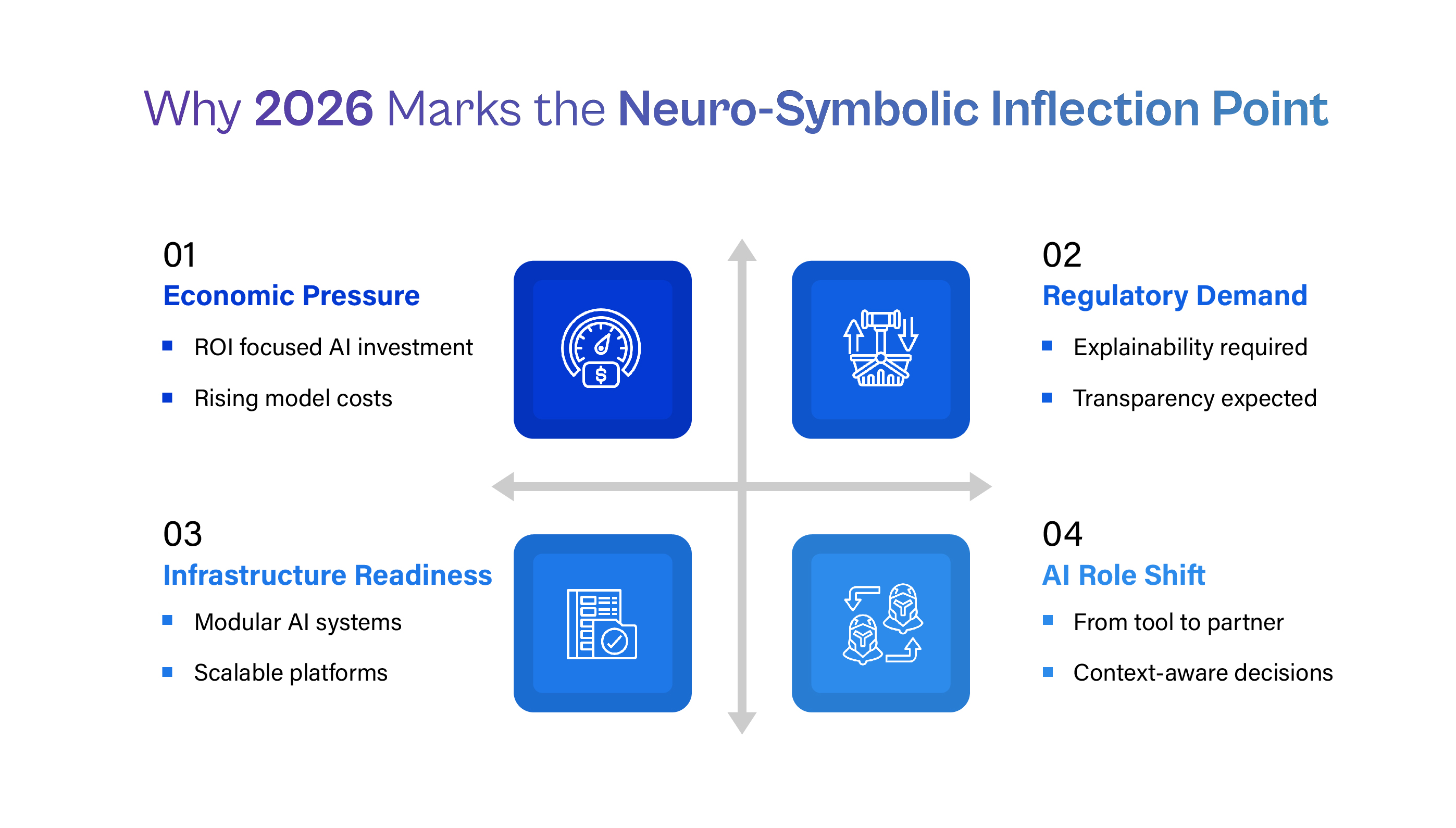
Economic Pressure and ROI Focus
- Context shift: Global AI investment continues to rise, yet enterprises are now moving beyond experimental success metrics toward performance metrics based on operational efficiency, scalability, and sustained business value.
- Financial accountability: AI budgets are increasingly migrating from innovation funds into core operating expenses, placing direct responsibility on CIOs and transformation leaders to justify every deployment.
- Market signal: Gartner projects a sharp increase in global AI spending, intensifying executive focus on solutions that balance performance with financial sustainability (Gartner, 2025).
- Cost reality: Rising training costs for large-scale neural models push organizations to reduce redundancy and optimize existing capabilities.
- Strategic response: Neuro-symbolic AI mitigates this pressure by enabling the structured reuse of organizational knowledge rather than repeated model retraining.
- Operational benefit: This approach reduces computational overhead, shortens development cycles, and improves deployment efficiency.
- Value transformation: Knowledge repositories evolve into scalable strategic assets rather than static information stores.
- Outcome priority: Enterprises now prioritise predictable performance and explainable results over raw model scale.
- Alignment advantage: Neuro-symbolic systems directly support precision-driven ROI and long-term financial accountability.
Regulatory Expectations
- Governance demand: AI now operates within frameworks that require strict accountability, transparency, and ethical oversight.
- Compliance pressure: Regulatory authorities increasingly mandate explainable automated decisions, especially within finance, healthcare, insurance, and public governance.
- Design implication: Compliance considerations now shape AI architecture from inception rather than functioning as post-deployment checks.
- Structural limitation: Traditional deep neural models struggle with transparency due to opaque internal logic.
- Risk exposure: Organizations face difficulty justifying outcomes that directly impact human welfare and financial security.
- Trust erosion: Lack of visibility into decision processes increases operational risk and undermines stakeholder confidence.
- Systemic solution: Symbolic reasoning introduces clear logical frameworks that link outcomes to defined rules and policies.
- Audit strength: Neuro-symbolic systems create traceable and defensible decision pathways that support regulatory scrutiny.
- Strategic integration: Transparency becomes a built-in design principle rather than a governance afterthought.
Infrastructure Maturity
- Architectural evolution: AI system design has shifted away from oversized monolithic models toward interconnected, modular ecosystems.
- Operational flexibility: Organizations now distribute AI functionality across departments, data platforms, and workflows to enhance scalability and responsiveness.
- System specialization: Modular frameworks allow AI components to focus on perception, reasoning, or execution independently.
- Technical capability: Modern infrastructure supports sophisticated orchestration from data ingestion through reasoning and action execution.
- Architectural compatibility: Neuro-symbolic AI aligns naturally with this layered structure by integrating learning and logic.
- Functional distribution: Neural models process raw data while symbolic components maintain structured reasoning and enforcement.
- Technology backbone: Cloud-native platforms and scalable compute environments provide stability for hybrid deployments.
- Adoption confidence: Infrastructure maturity empowers organizations to deploy systems that demonstrate structured intelligence rather than reactive prediction.
Role Shift from Tool to Partner
- Functional transformation: Artificial intelligence now extends beyond task execution into strategic collaboration.
- Organisational expectation: AI increasingly supports decision validation, workflow optimisation, and strategic advisory functions.
- Operational necessity: This role demands systems that understand business context and align actions with enterprise logic.
- Capability requirement: AI must assess competing priorities and justify recommendations with clarity.
- Model limitation: Traditional predictive systems lack the depth required for contextual interpretation and reasoning.
- Framework advantage: Neuro-symbolic systems enable AI to operate as a reasoning partner rather than a reactive assistant.
- Cognitive capability: These systems interpret intent and apply structured organisational logic consistently.
- Controlled adaptability: AI evolves within predefined boundaries shaped by domain expertise and governance parameters.
- Collaborative outcome: The synthesis of learning and structured thought enables intelligent partnership without sacrificing oversight.
Together, these forces converge to make 2026 a pivotal moment in the adoption of artificial intelligence. The discussion shifts from whether AI can perform to whether it can reason responsibly, justify decisions, and align with enterprise logic. Neuro-symbolic AI emerges as the architecture that meets these expectations, marking the transition from experimental intelligence to operational understanding.
Anatomy of a Neuro-Symbolic System
A neuro-symbolic system operates through a layered architecture that balances learning and logic in a coordinated framework. Each layer handles a distinct responsibility, yet works in close alignment to produce AI that delivers both adaptability and structured reasoning. This design enables machines to move beyond surface-level interpretation toward meaningful decision-making grounded in context, knowledge, and rule-based reasoning.
By separating perception from reasoning, this architecture ensures that real-world inputs are transformed into structured intelligence before any decision is made. The result is an AI system capable of explaining its choices, maintaining compliance, and adapting to complexity without sacrificing operational clarity or governance oversight.
Neural Perception Layer
The neural perception layer functions as the sensory interface of a neuro-symbolic system. It interprets unstructured inputs such as text documents, spoken language, images, and other raw data formats using advanced machine learning models. Through this process, it identifies entities, detects intent, extracts relevant features, and converts complex information into structured representations ready for further reasoning.
This layer plays a critical role in bridging the gap between chaotic real-world data and organized machine understanding. Automating the initial interpretation phase enables organizations to process large volumes of information efficiently while maintaining speed, accuracy, and real-time relevance.
Symbolic Knowledge Layer
The symbolic knowledge layer stores structured intelligence in formats such as ontologies, rule sets, taxonomies, and knowledge graphs. It defines relationships between concepts and applies logical principles that allow the system to interpret meaning rather than recognize patterns. This layer ensures that decisions align with predefined rules, policies, and operational constraints.
Through logical inference mechanisms, the system draws conclusions, validates assumptions, and detects inconsistencies in information. This structured reasoning enables transparency and traceability, making the decision-making process understandable and defensible across regulated environments.
Integration Engine
The integration engine connects the system's perceptive capabilities with its reasoning framework, orchestrating the flow of information between neural and symbolic components. It ensures that structured data from the perception layer aligns with the rules and logic in the symbolic layer, enabling the system to respond coherently and consistently.
This engine manages the decision flow by applying constraints, sequencing operations, and generating traceable outcomes. Every action that emerges from the system reflects a combination of learned insight and formal logic, reinforcing trust through structured transparency.
Strategic Outcome
This architecture enables AI to reason through challenges rather than relying solely on statistical prediction. The system evaluates context, applies rules, and justifies its decisions through logical steps, reducing unpredictability and improving reliability in complex environments.
By anchoring intelligence in structured reasoning, neuro-symbolic systems deliver outcomes that reflect consistency, accountability, and alignment with business logic. Organizations gain AI that mirrors human problem-solving patterns while maintaining machine-scale efficiency.
Where Neuro-Symbolic AI Delivers Immediate Impact
Neuro-symbolic AI delivers tangible value in environments where accuracy, regulation, and explainability are critical. It strengthens decision-making across sectors that demand structured reasoning and transparent operational logic.
By embedding intelligence into real-world decision systems, this approach supports industries that rely on both predictive accuracy and rule-based integrity.
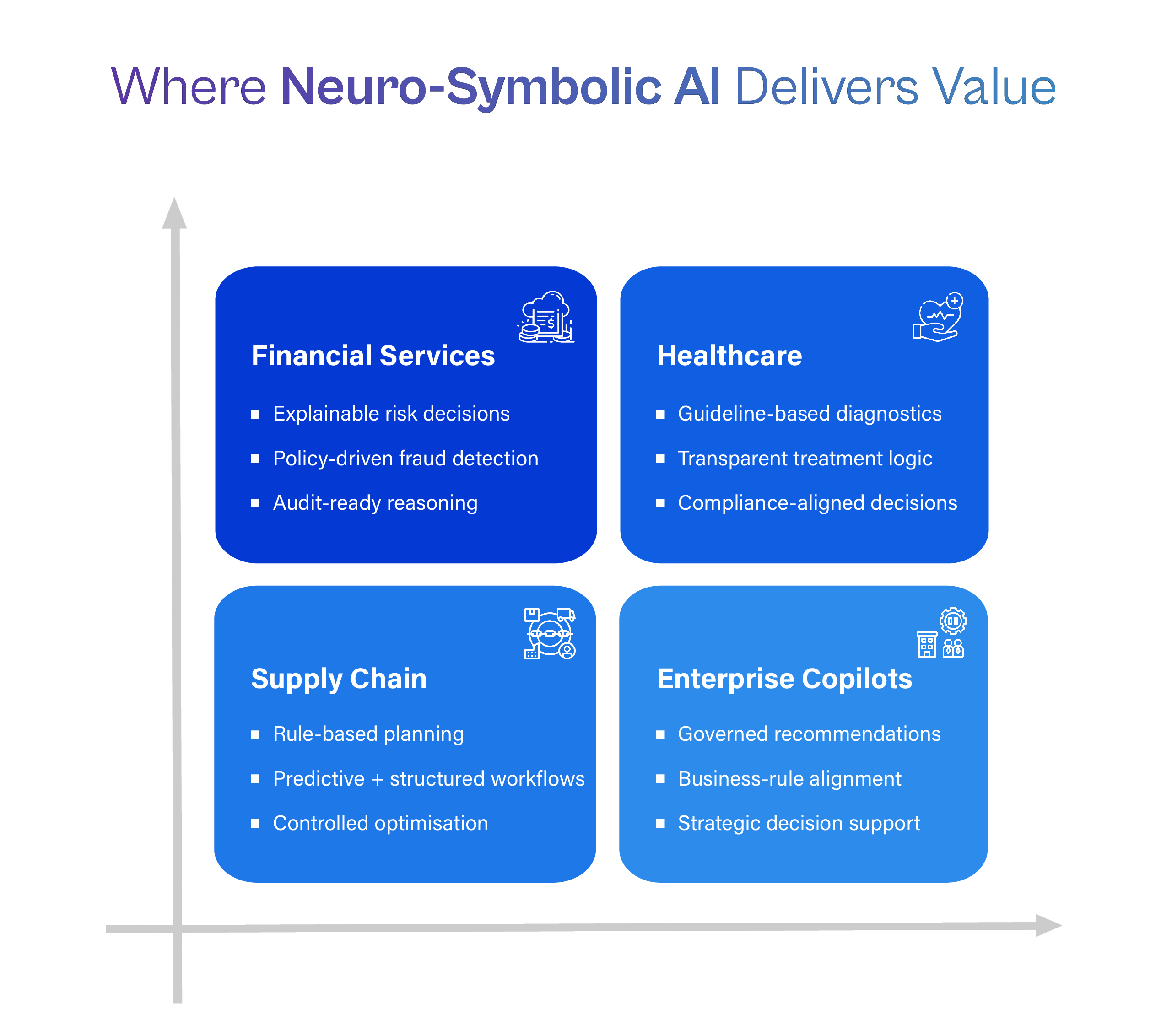
Financial Services
In financial services, organizations require AI systems that deliver transparent, justifiable risk assessments. Neuro-symbolic systems integrate predictive fraud detection with compliance-oriented rule engines, producing decisions supported by both data patterns and regulatory logic. This structure ensures every outcome connects to defined risk policies and governance standards.
Through explainable reasoning pathways, financial institutions can trace how specific inputs influenced decisions, improving audit readiness and reinforcing stakeholder trust. This capability supports regulatory compliance while allowing banks to maintain agility and operational efficiency.
Healthcare
Healthcare environments demand a careful balance between innovation and patient safety. Neuro-symbolic systems enhance diagnostic support by combining predictive AI with structured medical protocols and clinical guidelines. Recommendations remain adaptive to patient data while consistently respecting established treatment frameworks.
Clinicians benefit from AI that explains its reasoning, allowing them to evaluate and validate recommendations with confidence. This transparent methodology supports accuracy while reinforcing ethical and procedural accountability.
Supply Chain Management
Supply chains operate within rigid logistical constraints and volatile demand conditions. Neuro-symbolic AI strengthens decision-making by pairing forecasting models with symbolic planning systems that enforce operational rules. This integration allows organizations to respond effectively to disruptions without violating structural limitations.
By evaluating both predictive insights and logistical constraints, these systems optimize routing, scheduling, and resource allocation. The result improves operational resilience while maintaining efficiency and strategic consistency.
Enterprise Copilots
Enterprise AI assistants evolve from automation tools into governed decision-support systems through neuro-symbolic integration. These copilots understand organizational workflows, apply business rules, and provide guidance aligned with internal governance frameworks.
By combining reasoning capabilities with contextual understanding, they offer strategic recommendations that remain transparent and compliant. This transformation enables AI to function as a reliable collaborator rather than a reactive helper.
Strategic Implications for Organizations
Knowledge as an Asset
Codifying business knowledge into machine-readable formats transforms static information into a dynamic intelligence layer that actively fuels decision-making. When organizations structure policies, workflows, taxonomies, and domain expertise into ontologies and knowledge bases, they create a reusable foundation that strengthens every AI system built on top of it. This shift allows knowledge to function not as documentation but as a strategic infrastructure that continuously evolves with operational needs.
Organizations that invest in robust knowledge architecture unlock scalable intelligence that extends far beyond isolated projects. They reduce dependency on repeated model retraining, preserve institutional memory, and maintain consistency across departments. Over time, this approach converts fragmented information into a self-reinforcing intelligence ecosystem that supports both automation and strategic insight.
System-Oriented AI Design
Modern enterprises must move beyond fragmented AI deployments and adopt system-wide architectures that harmonise learning with reasoning. Instead of building isolated models for individual tasks, organizations now design integrated ecosystems where perception engines, reasoning frameworks, and operational workflows function as a cohesive whole. This system-oriented architecture enhances reliability, scalability, and adaptability.
By integrating symbolic reasoning engines with adaptive neural learning systems, organizations create AI that balances flexibility with structure. This design ensures that models not only respond to data but also honour defined logic, policies, and operational boundaries. As complexity increases, system-level coordination becomes essential for sustainable AI performance.
Workforce Evolution
The rise of neuro-symbolic AI reshapes workforce dynamics by demanding cross-functional expertise that blends technical and domain-driven knowledge. Teams must now understand both machine learning pipelines and knowledge engineering principles while remaining fluent in business processes and compliance requirements. This convergence transforms AI roles from purely technical positions into multidisciplinary strategic functions.
Organizations that cultivate such talent can design AI systems with precision and contextual intelligence. Employees become architects of reasoning systems rather than model operators, ensuring that AI solutions remain aligned with organizational strategy, ethics, and governance standards.
Governance Reinforcement
Neuro-symbolic AI enables organizations to embed compliance directly into operational architecture. By generating transparent reasoning paths and traceable decision logic, these systems support internal audits, regulatory reviews, and risk management processes with clarity and accountability. Every outcome becomes verifiable, defensible, and governed by structured rules.
Rather than enforcing governance through reactive oversight, organizations shift toward proactive compliance embedded within system design. This approach enhances organizational resilience by reducing legal exposure, strengthening trust, and ensuring that AI behaviour aligns with defined ethical and legal frameworks.
Practical Adoption Roadmap
The successful integration of neuro-symbolic AI requires a deliberate, phased approach that bridges technical deployment with organizational strategy. Organizations should begin by identifying high-risk or high-impact decision areas where transparency, accuracy, and rule-based logic are critical. These areas serve as ideal starting points for demonstrating value and establishing confidence.
Once priority zones are defined, organizations must convert existing business rules, policies, and domain knowledge into structured, machine-readable formats. Neural perception systems can then extract meaningful data from unstructured sources, feeding structured insights into symbolic reasoning engines. Over time, feedback loops refine system behaviour, and successful implementations scale across departments to create unified intelligence ecosystems that support enterprise-wide transformation.
What Neuro-Symbolic AI Doesn't Promise
Neuro-symbolic AI does not eliminate complexity, nor does it replace human oversight. Organizations must still design clear rules, curate knowledge, interpret outcomes, and monitor system performance. Human judgment remains central, particularly in scenarios involving ethical considerations, ambiguity, or nuanced decision-making.
What this approach offers is control, not autonomy without responsibility. It strengthens governance, improves accountability, and reduces unpredictability, but its success depends on thoughtful implementation. Organizations that treat neuro-symbolic AI as a strategic partnership — rather than a fully autonomous solution — reap the highest value.
Redefining Machine Understanding
An accurate understanding of AI extends beyond data prediction. It involves representing meaning in structured formats that machines can interpret, reasoning over this structure through logical decision processes, and adhering to predefined rules that reflect real-world constraints. Transparency plays a central role, ensuring that each action or recommendation remains traceable and justifiable.
Continuous, responsible adaptation further defines this understanding. Systems learn from new data while respecting governance and ethical boundaries. Neuro-symbolic AI approaches this model by combining learning with structured cognition, moving machines closer to intelligence that mirrors human reasoning without sacrificing operational integrity.
Conclusion: Preparing for 2026
As artificial intelligence moves deeper into the core of business operations, the demand for systems that merely perform is giving way to the need for systems that genuinely understand. The rise of neuro-symbolic AI marks a critical turning point in this journey, where learning and logic unite to create intelligence that reasons, explains, and aligns with real-world constraints. This shift responds directly to the growing expectations of enterprises that want AI to deliver not only speed and scale, but also accountability, transparency, and strategic coherence.
By 2026, organizations that embrace neuro-symbolic architectures will position themselves ahead of this transformation curve. These systems will not replace human judgment but will elevate it, offering structured insights that support better decisions, stronger governance, and sustainable innovation.
As businesses navigate increasingly complex environments, neuro-symbolic AI will stand as the foundation for trusted intelligence, where machines move beyond surface-level prediction and begin to reason through decisions with clarity, purpose, and accountability. These systems will enhance human judgement, providing structured insights that support better governance, stronger decision-making, and sustainable innovation across enterprise functions.
Move beyond prediction to structured intelligence.
Partner with Cogent Infotech to design neuro-symbolic AI systems that combine learning, logic, and governance for high-stakes business environments.

