Leading Through AI Disruption: How to Empower People in a Machine-Augmented World



Introduction: Leading in the Age of AI
Artificial Intelligence is no longer a distant innovation; it’s the engine driving today’s most significant transformation. Across every industry, AI is reshaping how businesses operate, make decisions, and deliver value. What makes this disruption different from previous technological waves is its speed, scale, and depth. It’s not just about automating processes; it’s about redefining roles, reimagining customer experiences, and challenging the very way organizations think and operate.
For leaders, this moment calls for more than just adopting new tools or following trends. It demands a complete shift in mindset from managing resources to cultivating intelligence across people, systems, and strategies. Successful leadership in the AI era means striking a balance between technology and humanity, fostering curiosity, empowering teams to learn and adapt, and ensuring that innovation remains aligned with ethics and purpose.
In short, leading through AI disruption isn’t about keeping up; it’s about shaping what comes next. It’s about guiding your organization to not only survive this change but to thrive in it, by turning disruption into a catalyst for smarter, more resilient growth.
Understanding the Nature of AI Disruption
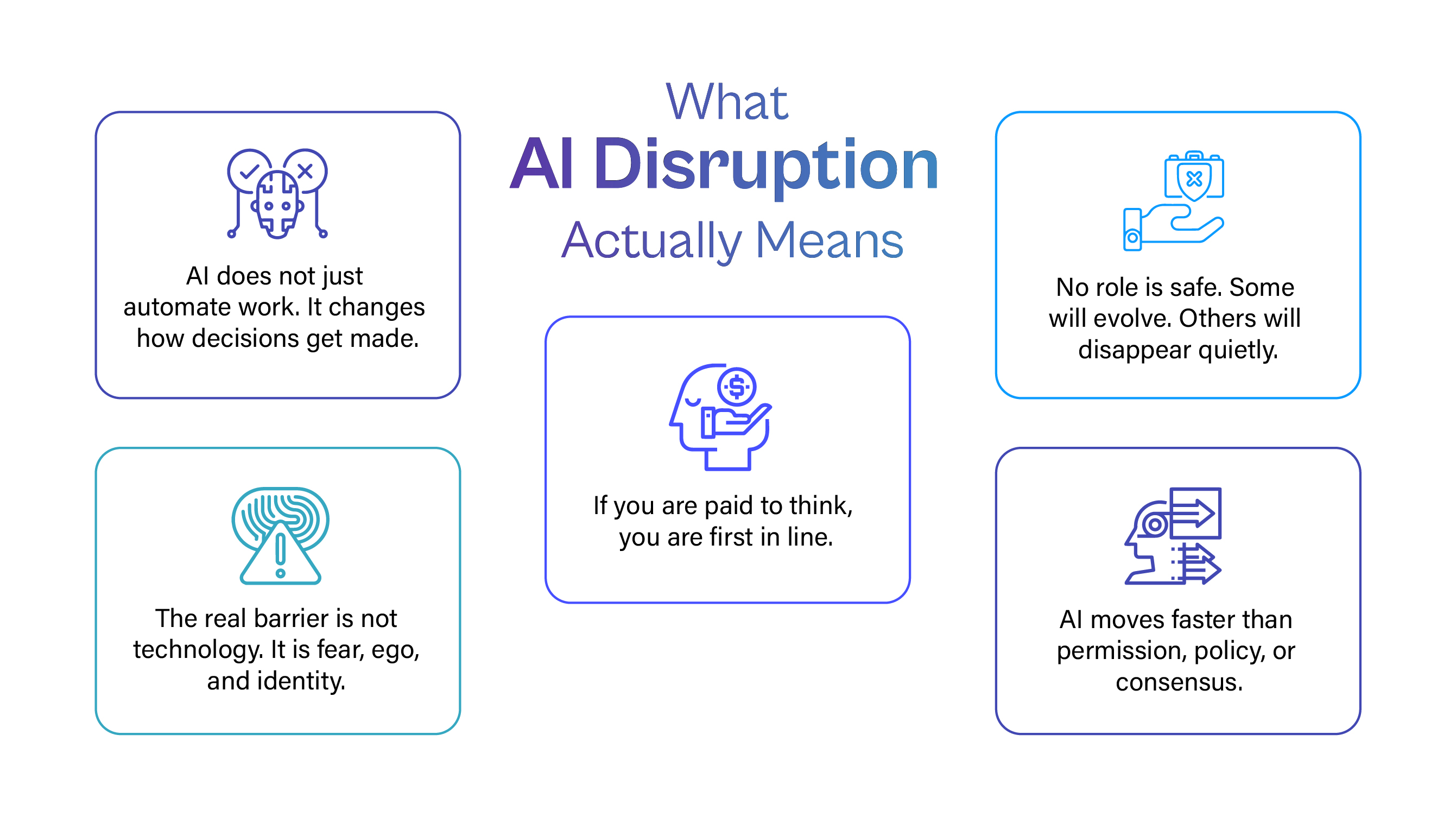
Artificial Intelligence isn’t just about faster automation or more intelligent machines; it’s about redefining what intelligence itself means. For the first time, technology is venturing into areas once believed to be uniquely human, including creativity, judgment, empathy, and decision making. This makes AI not just another wave of innovation, but a full scale transformation that’s reshaping the foundations of how organizations think, operate, and lead.
Unlike previous industrial revolutions that primarily disrupted manual work, AI challenges leaders and knowledge workers first. It challenges long held assumptions about expertise, authority, and even identity in the workplace. In this new reality, three truths stand out,
- No one is immune: Every role, from the front line to the boardroom, will evolve under the influence of AI.
- Learning never ends: Continuous learning and adaptability are no longer optional; they’re the new baseline for relevance.
- The hardest change is psychological: Fear, uncertainty, and resistance often slow transformation more than the technology itself.
AI disruption moves at an exponential pace, crossing industries and borders simultaneously. To lead effectively through it, speed, curiosity, and the willingness to unlearn outdated patterns now matter just as much as vision and execution. This is why AI isn’t simply another tech trend; it’s a system level shift that demands an entirely new way of leading and learning.
From Command and Control to Curate and Coach
The old model of leadership was built on control, direction, and having all the answers. However, in the age of AI, that approach is no longer practical. Today’s leaders aren’t commanders, they’re curators and coaches. Their job isn’t to dictate every move, but to create environments where people and machines can learn, experiment, and grow together.
In this new era, leadership is less about authority and more about enabling others to think faster, adapt quicker, and innovate smarter. The modern leader acts as a sense maker, helping teams interpret complexity and find clarity amid rapid change.
Humility has become a true superpower. Great leaders openly admit when they don’t know something, learn alongside their teams, and model curiosity instead of certainty. They turn uncertainty into an opportunity for discovery and see mistakes not as failures, but as stepping stones to insight.
AI may be rewriting the rules of work. Still, it’s also giving leaders a chance to redefine what leadership really means: guiding with empathy, empowering with trust, and growing through continuous learning.
The Evolving Skillset of Modern Leaders
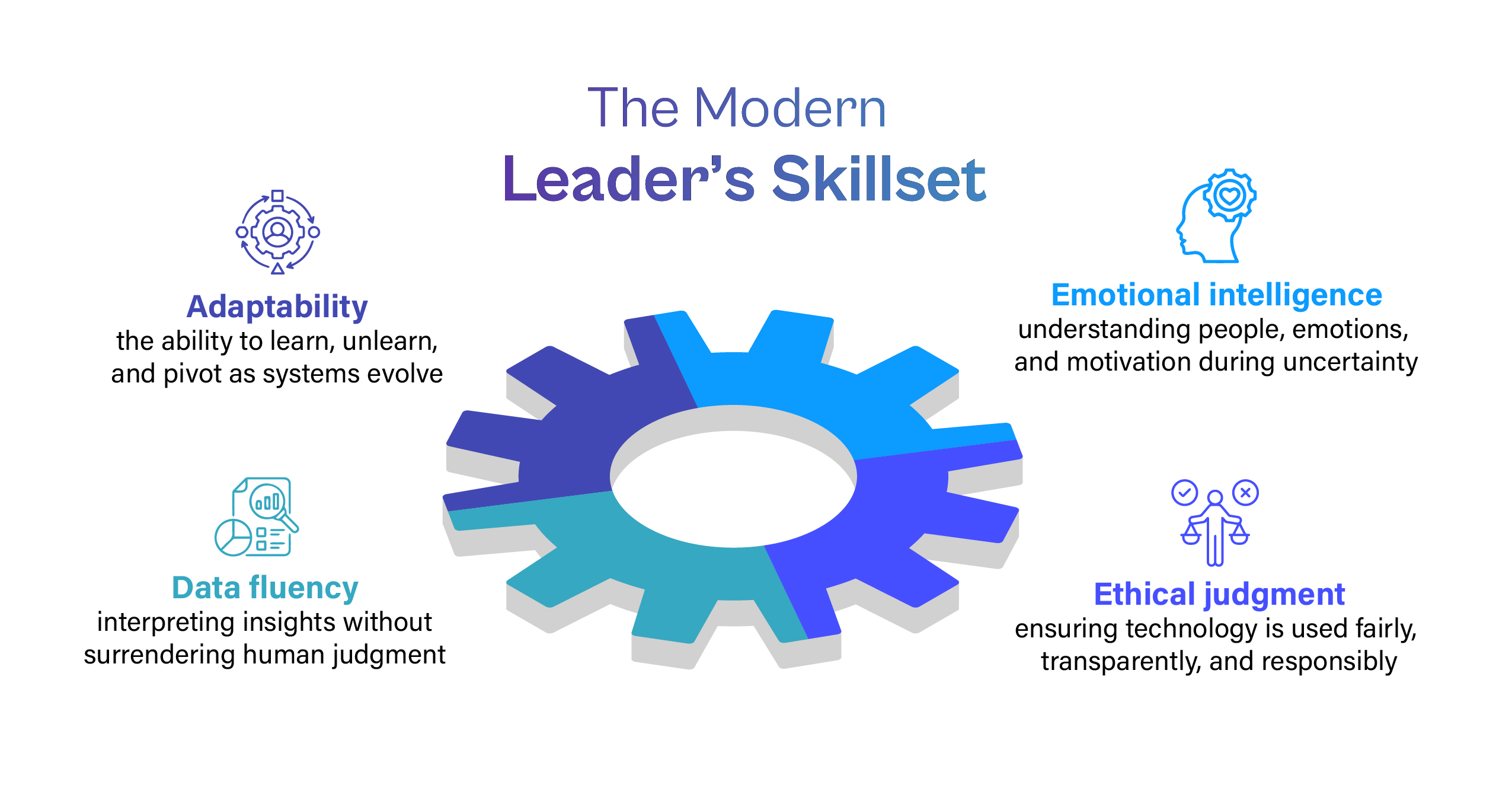
In the AI era, leadership is no longer defined by authority or experience; it’s shaped by adaptability, empathy, and digital fluency. Leaders must strike a balance between human understanding and technological insight, guiding teams through rapid change with both confidence and compassion.
Adaptability is now essential. The best leaders learn, experiment, and pivot quickly as the world evolves. Emotional intelligence has become equally vital because while AI can analyze data, only humans can connect, inspire, and build trust.
Ethical judgment sits at the heart of modern leadership. As technology increasingly drives decision making, leaders must ensure fairness, transparency, and accountability. And with data fluency, they can bridge human intuition and machine intelligence, ensuring tech serves strategy, not the other way around.
The leaders of tomorrow will be part visionary, part humanist, and part technologist, guiding with empathy, acting with integrity, and growing through continuous learning.
Building Trust Amid Uncertainty
As AI transforms the way we work, it also raises significant questions about ethics, privacy, and job security. In times like these, pretending to have all the answers only creates more doubt. What people really want from their leaders isn’t perfection, it’s honesty and empathy.
Transparency has become the new currency of leadership. When leaders openly share what’s changing, what’s still unknown, and how the organization plans to adapt, it fosters confidence rather than fear.
Employees don’t expect certainty, but they do expect clarity. When leaders take the time to explain what AI means for roles, skills, and the company’s direction, anxiety turns into engagement.
Trust grows strongest when teams see their leaders learning, experimenting, and evolving right beside them. In an era defined by rapid change, authentic communication and shared learning are what keep people and organizations grounded.
Building an AI Ready Culture
Technology may power AI, but culture determines whether it truly succeeds. The organizations that thrive in the AI era aren’t just the ones with the best tools; they’re the ones with the right mindset. An AI ready culture is built on openness, curiosity, and continuous learning. Teams are encouraged to ask questions, share ideas, and experiment without fear of failure. When people feel safe to try, learn, and adapt, innovation follows naturally.
Open communication ensures that everyone is aligned on what AI means for their work and goals. Learning agility ensures that employees grow alongside technology, rather than feeling replaced by it. And psychological safety, the freedom to speak up and take risks, turns uncertainty into creativity. In the end, building an AI ready culture isn’t about teaching people to code; it’s about helping them think, collaborate, and evolve with confidence. Because when culture leads, technology follows.
Strategy: Vision with Velocity
Leading with AI isn’t just about moving fast; it’s about moving with purpose. The best leaders strike a balance between speed and strategy, recognizing that momentum without purpose can quickly lose direction. An effective AI strategy starts with a clear “why.” It’s not about chasing trends or automating for efficiency’s sake; it’s about connecting AI initiatives to a deeper purpose, improving lives, empowering teams, and creating lasting value.
Next comes focus. Instead of trying to do everything, visionary leaders prioritize high impact use cases, the ones that truly redefine how their organizations create value. From there, it’s about empowering teams to experiment boldly but responsibly. The goal is to make progress within clear ethical boundaries, learning quickly without cutting corners. Strong strategies also include feedback loops, measuring not just ROI, but how much the organization is learning and adapting along the way.
Finally, when something works, scale it quickly. Winning organizations don’t chase every innovation; they double down on what aligns with their mission, values, and trust. In the AI era, strategy is no longer a static plan; it’s a living system of purpose, learning, and speed.
The Human Side of AI Leadership
AI is changing how we work, but it doesn’t change what makes us human. While machines take on tasks, people still bring the creativity, empathy, and judgment that technology can’t replicate. The real challenge isn’t automation itself, it’s the fear of becoming irrelevant in a world that’s moving faster every day.
Strong leaders understand this. They acknowledge those fears openly, rather than brushing them aside. Honest conversations about how AI will reshape roles and workflows help replace anxiety with trust.
Next, great leaders redefine work, positioning humans where they add the most value, solving problems, building relationships, and making ethical decisions. They see AI not as a replacement, but as a partner that amplifies human potential.
Most importantly, they treat upskilling as a leadership responsibility, not just an HR initiative. By creating space for learning and experimentation, they ensure that growth becomes part of everyday work.
Organizations that embed learning into their culture will find that AI isn’t a threat; it’s an ally. When people feel equipped and empowered, innovation flourishes, and technology becomes a force for progress, rather than a source of pressure.
Redefining Decision Making
AI is transforming not just what we decide, but also how we make decisions. The old idea of being “data driven” is evolving into something more balanced, being data informed. Leaders today use AI as a thinking partner, a tool to test their instincts, not replace them. Machines are brilliant at spotting patterns, predicting outcomes, and optimizing results. But humans bring what algorithms can’t: context, ethics, and empathy. The most effective leaders blend both, combining AI’s precision with human wisdom. They know that good judgment still comes from asking the right questions, not just following the data.
In this new model, leadership operates in “perpetual beta”, constantly learning, adapting, and refining strategies as fresh insights emerge. There are no final answers, only better ones. AI may accelerate decision making, but it’s human understanding that keeps it grounded, fair, and meaningful.
Managing Identity and Ethics
As AI reshapes the workplace, it also stirs a deeper question for many: Where do I fit in? As roles evolve and technology assumes more decision-making responsibilities, people naturally begin to question their value and identity at work.
Great leaders don’t ignore this; they help their teams see change as renewal, not replacement. They demonstrate how technology can amplify human strengths, such as creativity, empathy, and critical thinking, rather than compete with them. When people understand that AI is a tool to enhance their impact, not erase it, confidence replaces fear.
At the same time, ethics must remain non negotiable. As AI gains more influence, leaders have a duty to ensure that decisions are transparent, fair, and accountable. This means asking tough but essential questions:
- Are our algorithms explainable and unbiased?
- Are we protecting data and privacy responsibly?
- Are we reskilling and including workers affected by automation?
Ethical foresight builds trust long before any regulation demands it. Leaders who prioritize both human dignity and technological responsibility will guide their organizations and their people through AI disruption with integrity and purpose.
Leading with Humility and Curiosity
In the age of AI, humility has become a true strategic advantage. No leader can claim to have all the answers anymore, and that’s precisely why curiosity matters more than ever. The best leaders are listeners first. They invite diverse, tech fluent voices to the table, ask questions without ego, and create space for ideas to emerge from anywhere in the organization. They understand that progress in the AI era depends on collective intelligence, rather than command and control thinking.
AI thrives on iteration, testing, learning, and improving continuously. Leadership must do the same. When leaders view experimentation (and even failure) as opportunities for growth, they cultivate organizations that naturally adapt to change. Curiosity fuels learning. Learning drives innovation. And innovation sustains relevance. In a world that never stops evolving, staying curious isn’t just good practice; it’s the key to staying ahead.
The Future Leader’s Blueprint
The leaders of tomorrow won’t just manage change, they’ll design for it. In the age of AI, leadership is no longer about control or certainty; it’s about building organizations that can adapt, learn, and grow at the speed of technology.
Future ready leaders will treat AI as a teammate, not just a tool, collaborating with machines to enhance human creativity and insight. They’ll measure success not by how steady things stay, but by how quickly teams can adapt and evolve. Ethics will sit at the heart of every decision, guiding how AI is used, shared, and scaled. Authentic leadership means striking a balance between digital precision and human compassion, ensuring that technology serves people, not the other way around.
The most successful organizations will build cultures where learning outpaces change, where curiosity is celebrated, and failure becomes a step toward innovation. AI won’t replace leaders. But leaders who embrace AI with courage, empathy, and adaptability will shape the next chapter of progress. The defining skill of this decade isn’t technical mastery; it’s the willingness to learn, unlearn, and lead humanely in a machine augmented world.
Conclusion: Leading Forward, Not Just Through
AI is not just transforming technology; it’s transforming leadership itself. The leaders who will define this era aren’t the ones with the most data or the flashiest tools, but rather those with the wisdom to utilize them effectively. They’ll lead with empathy, curiosity, and courage, combining human judgment with digital intelligence to create organizations that learn more quickly, adapt more effectively, and act with integrity.
The future doesn’t belong to those who fear disruption, but to those who embrace it as evolution. Leadership in the age of AI isn’t about keeping control; it’s about creating conditions where people and machines can grow together. As AI accelerates change, one truth remains: outstanding leadership is, and always will be, human at its core. The tools may evolve, but trust, purpose, and learning will always be the foundation.
The leaders who thrive will be those who don’t just navigate the AI revolution, they’ll humanize it, turning technology into a force for progress, inclusion, and collective intelligence.
Level up your leadership for the AI future.
Discover how Cogent Infotech empowers learners to combine human insight with digital intelligence.
Real-World Journeys