


Designing Intent: The New Frontier of Software Development in the GenAI Era



The software development domain is undergoing a significant transition. Generative AI is a significant catalyst that is radically changing how we design, develop, modernize, and maintain software. It is not just a trend. According to a report by McKinsey, GenAI is expected to contribute between $2.6 trillion and $4.4 trillion to global GDP annually across industries by 2030, positioning it to have a significant economic impact. This increase in investment is a reflection of GenAI's revolutionary potential, especially in terms of improving efficiency, optimizing business procedures, and changing value chains across industries
According to PwC analysts, a development team can experience performance gains of 20% to 50% by using GenAI code-generating tools. AI significantly impacts code generation. NLP is used by machine learning-enabled systems to read natural language descriptions and generate code suggestions or full code. This feature speeds up intent-driven development, lowers human error, and frees engineers from boilerplate code to concentrate on more intricate and imaginative jobs. By anticipating the next lines of code or even creating entire functions, AI-powered autocompletion and code synthesis significantly increase efficiency.According to
PwC analysts, a development team can experience performance gains of 20% to 50% by using GenAI code-generating tools.
AI significantly impacts code generation. NLP is used by machine learning-enabled systems to read natural language descriptions and generate code suggestions or full code. This feature speeds up intent-driven development, lowers human error, and frees engineers from boilerplate code to concentrate on more intricate and imaginative jobs. By anticipating the next lines of code or even creating entire functions, AI-powered autocompletion and code synthesis significantly increase efficiency.
GenAI workflows have historically been quite good at data interpretation and analysis. It creates original content, from architectural blueprints and code snippets to full application modules in increasingly complex settings. Machine learning models and deep learning approaches are used by AI developer tools to adapt and evolve, resulting in more effective coding practices and project outputs.
Why AI-First Software Is the Next Big Shift Beyond Traditional Automation
Generative AI is far more than just automation. Compared to previous AI models that carried out specialized, repetitive tasks like pattern recognition, it focuses on creating completely novel outputs. Massive datasets, advanced algorithms, and more readily available, potent computational resources are the primary causes of the present AI revolution, which will continue to pick up steam until 2025.
We are already observing this trend's advanced development. AI's increasing creative potential is demonstrated by programs like GitHub Copilot and its more recent, integrated successors. They help developers by creating code, making function recommendations, and even reworking difficult passages. These achievements demonstrate how AI is evolving into an essential intelligent co-pilot for development teams.
What Happens When the Product Strategy Doesn’t Align With the Technical Strategy?
Roadmap and Ownership are two crucial aspects where skipping them can quickly lead to failure, even though collaborative meetings or whiteboarding sessions are essential. Several issues can arise quickly if the engineering and product departments are at variance about what features they want to develop and when, or if they lack clear ownership metrics for who will make the choices about planning and execution.
- Among the most frequent ones are launch delays, resource limitations, organizational conflict, and increasing costs.
- Compared to the previously mentioned, an excessive dependence on execution strategy (the how?) can occasionally impede "the what" and "the why" when engineers are drawn into deeper strategic conversations that address questions like what should we construct, along with the "how to" and "can we" build it.
- The trust between the two teams can be rapidly damaged if product managers consistently receive "No" or "Maybe" responses to the majority of their suggestions from technical colleagues.
- It is crucial to understand that utilizing the latest technology for product development is frequently not the primary objective of a technical strategy. Finding the best or most creative intent-driven development strategy is also not the goal. In actuality, these cutting-edge tech stacks have limitations on integration and scalability of their own.
- Attempting to concentrate on creating the most cutting-edge tech strategy could lead to the "wrong" kind of technical debt in the future and impede the expansion of both products and customers.
Considering how quickly the market is evolving, speed is also a crucial component. If the once-visionary product does not materialize quickly enough, it could swiftly become outdated due to such rapid changes in consumer behavior.
What Is Design Intent: A Quick Overview
Design intent is a strategy used in computer-aided design to describe relationships between items so that changes to one affect the others automatically. It is crucial in reverse engineering, which involves taking measurements from an existing part and creating a CAD model for record-keeping and design revisions.
Additionally, design intent usually necessitates more work and time during the original design process, even if these various methodologies and design intent aren't always mutually exclusive. However, when the product needs to eventually change, particularly in complicated assemblies with multiple interdependencies, this additional effort from the outset saves a substantial amount of time and money.
The Crucial Role of a System Designer
- Understanding Requirements: Imagine you are assigned to create a brand-new mobile banking app for a major financial company. Understanding the project's needs is the first step for a system designer. This entails gathering information about the needs, goals, and limitations of stakeholders, including bank executives, product managers, and end users, through meetings. You develop an extensive understanding of the project's functioning, security needs, and compliance standards through efficient communication and teamwork. Given this information, you set the stage for success by coordinating the design process with the overall objectives of the project.
- Designing Scalable Architectures: It's time to create a scalable architecture that can support future expansion and change now that you have an understanding of the project's needs. You propose a modular design based on microservice ideas for the mobile banking application. You create a system in which every functional element, like transactions, account management, and customer service, is contained within a separate microservice. Each component can be independently developed, deployed, and scaled because of this modular architecture, which ensures adaptability as the application evolves.
- Testing and Iterating: Now that the basic plans have been put into practice, it's time to test them. You collaborate closely with quality assurance teams to carry out thorough testing in order to find bugs, usability problems, and performance bottlenecks. You continuously enhance the design by methodically iterating and refining it in an effort to get the best possible performance, scalability, and user experience.
What are the Common Responsibilities of a Programmer/Coder?
By creating, testing, and maintaining code, programmers are in charge of transforming concepts into useful software. Although their specific obligations may vary depending on their position and area of expertise, the following are some typical tasks that are carried out by professionals in the field:
- Maintaining and Optimizing Codebases: Developers must maintain and improve current codebases to increase security, reliability, and efficiency, in addition to writing new code.
- Debugging & Troubleshooting: Finding and fixing errors is a fundamental aspect of coding. Coders have to assess problems, evaluate possible solutions, and put them into practice effectively. If you have a strong interest in problem-solving, you might want to look into a quality assurance boot camp where you can focus on software testing and debugging.
- Writing & Running Tests: Code operates as intended because of both automated and manual testing. To find defects early and preserve overall software quality, programmers frequently create unit tests.
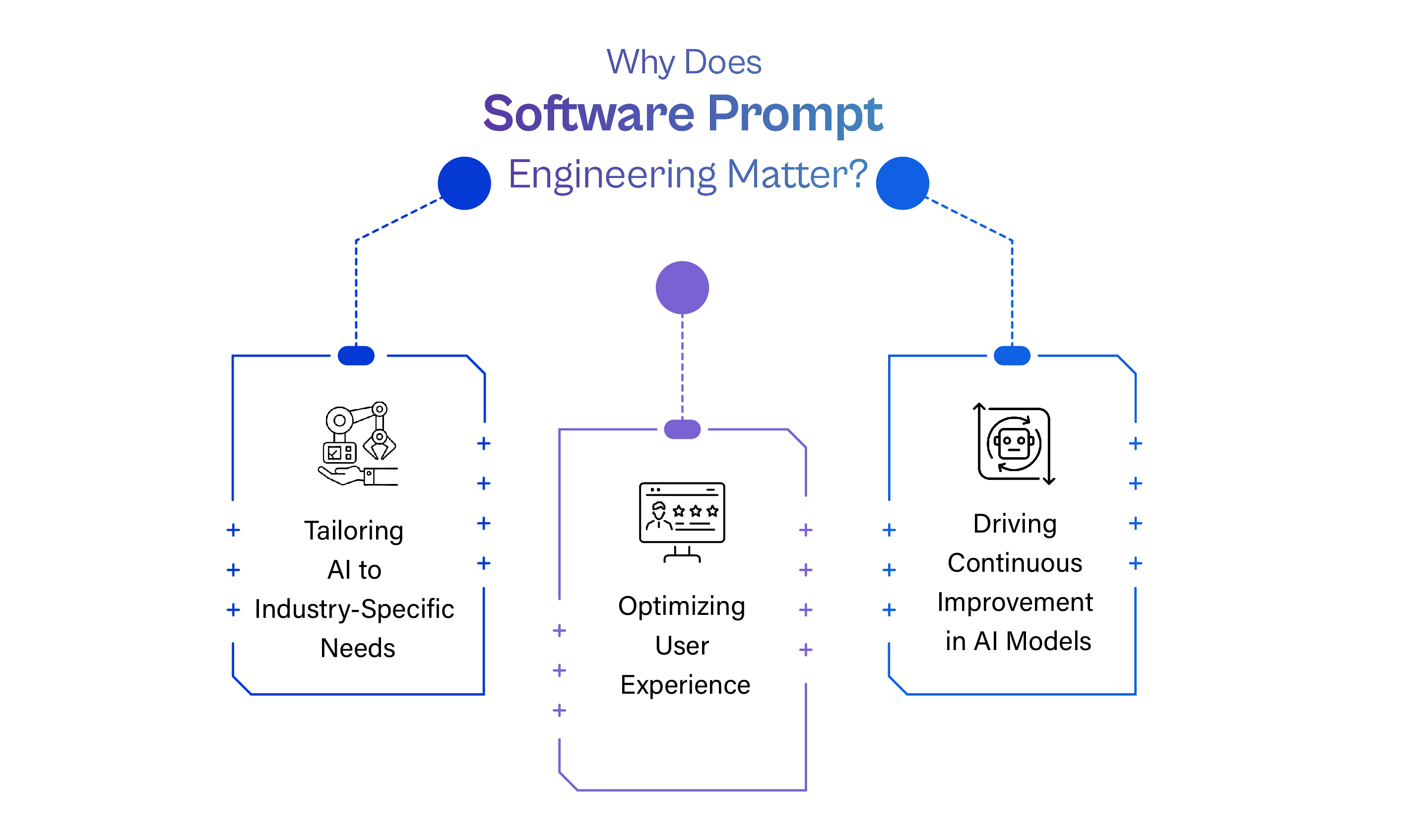
Why Does Software Prompt Engineering Matters?
A crucial skill for anyone working with Large Language Models (LLMs) is prompt engineering. This field gives AI models a clear structure, ensuring that replies are correct and in line with certain business goals. Organizations can use AI to improve decision-making, boost operational effectiveness, and gain a competitive edge by optimizing prompts to match organizational strategies. The complexity of the prompts used has an unbreakable connection to the effectiveness of AI in tasks like content creation, natural language processing, and advanced problem-solving.
1. Tailoring AI to Industry-Specific Needs
The flexibility of customizing AI models for industry-specific applications is one of software prompt engineering's main benefits. Organizations can greatly improve the accuracy and relevance of AI-generated outputs by matching prompts to the particular requirements of a certain industry. By 2027, more than half of the GenAI models used by businesses will be industry or business-specific. For instance, prompt engineering can be used in the healthcare sector to create prompts that precisely respond to medical questions, ensuring the delivery of reliable information.
2. Optimizing User Experience
Software prompt engineering is essential for enhancing user experiences by optimising the way GenAI systems interact with users. Businesses can ensure that AI-generated responses are accurate and align with the user's goal by developing prompts that are concise, easy to understand, and contextually aware. This is especially important in applications like chatbots for customer care, virtual assistants, and automated assistance systems, where smooth communication is essential.
3. Ensuring Strong Ethical Standards
Prompt engineering assists in reducing flaws and ensuring fairness in Generative AI outputs in a time when ethical AI practices are being scrutinized more and more. Organizations should proactively address potential biases and maintain the ethical integrity of their AI systems by carefully crafting prompts and regularly auditing content produced by AI. This is both a technological necessity and a strategic imperative since biased AI responses can have a substantial impact on regulatory compliance and brand reputation.
4. Driving Continuous Improvement in AI Models
According to Gartner, by 2025, 39% of worldwide organisations will be in the testing stage, and 14% will be in the expansion stage. Additionally, software prompt engineering makes it easier for AI models to be continuously improved. Organizations can make sure that their AI systems adapt to changing consumer expectations and market demands by iterating on prompt design, assessing results, and modifying inputs. For AI-driven solutions to remain relevant and effective, this iterative approach to prompt optimization is essential.
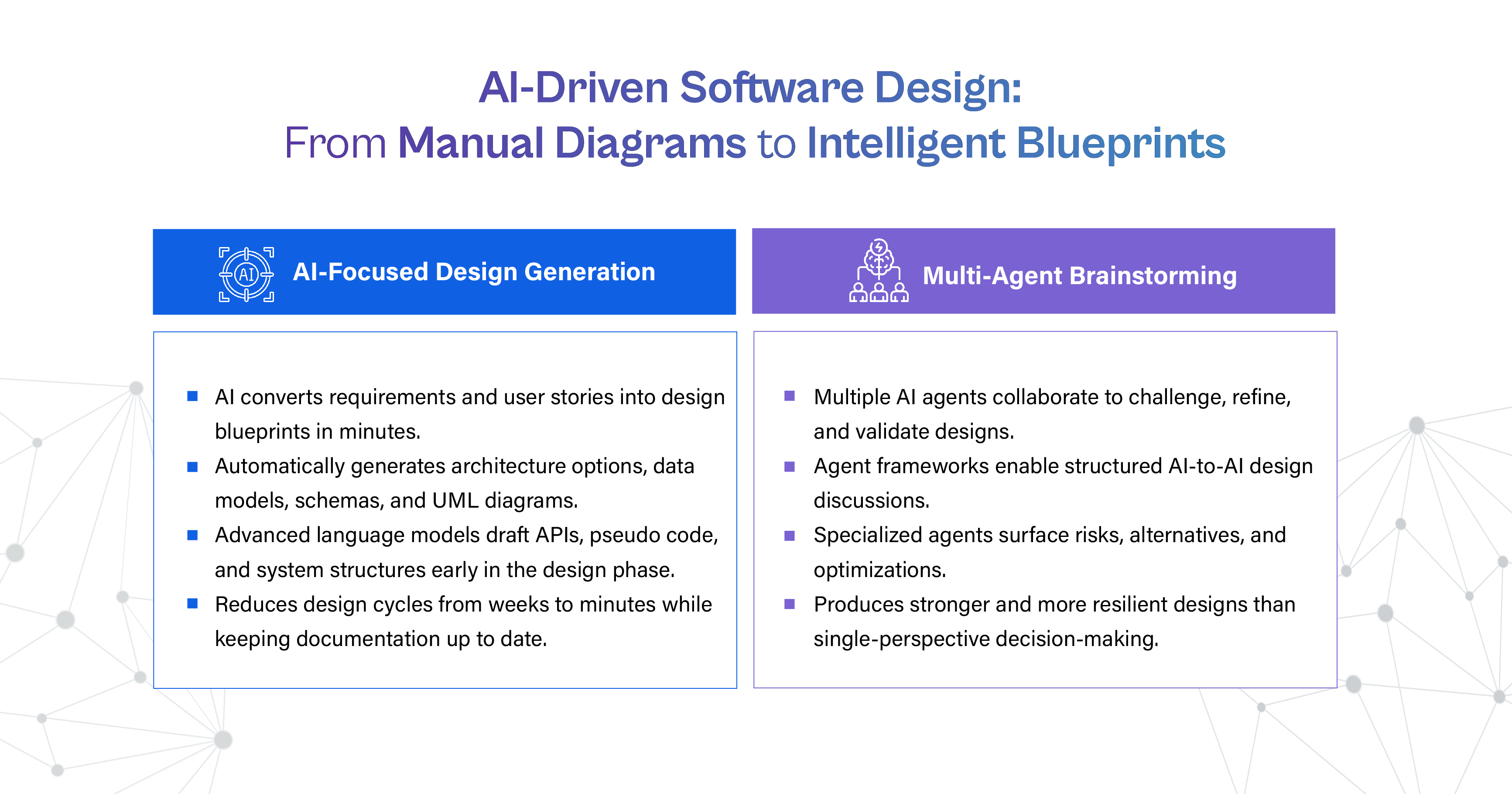
Design (HLD/LLD): From Manual Diagrams to AI-Generated Blueprints
Architects typically create Low Level Designs (LLD) and High Level Architecture (HLD) when needs are established. This can require weeks of meticulous planning and diagramming, and by the time it is put into practice, the outcome is frequently out of date.
- AI-Focused Design Generation
Generative models can draft a large portion of the design work in an AI-first approach. An AI agent can suggest an architecture based on a set of requirements or user stories. For example, it could suggest data models, identify necessary services or classes, and even create preliminary UML diagrams or flowcharts.
Researchers have generated database schemas and pseudo-code from natural language using GPT-4. In certain prototyping tools (and research papers), an "architect agent" makes recommendations about how to create an API contract or divide a system into microservices, which a "developer agent" can then carry out.
- Multi-Agent Brainstorming
AI agents can work together to improve designs as well. Several AI agents (or an AI and a human) converse to resolve an issue using a multi-agent framework such as Microsoft's AutoGen, Manus AI, or Google Agentic AI. Imagine a "Performance Agent" suggesting caching layers for scalability, a "Security Agent" pointing out possible data privacy concerns, and a "Architect Agent" suggesting a microservice split. AutoGen particularly enables LLM-based agents to communicate and collaborate on tasks; thus, this isn't science fiction.
An agent brainstorming session could result in a design that is much more carefully thought out than what a single human architect could create on their own (and in minutes). Human engineers and architects then direct and validate these AI-suggested ideas by adding real-world constraints that the AI might not be aware of.
Key Benefits of Using GenAI Agents in Software Development
Engineering teams can gain a lot from implementing GenAI workflows in software development. Below mentioned are the four primary benefits:
1. Enhanced Efficiency
A predictable stream of work is produced by common operations in well-designed systems, which frequently follow a constant pattern. Consider the process of implementing a new service and making it available as a collection of RESTful API endpoints. The service can be defined by a human developer in their preferred programming language and implemented as a class with methods. A GenAI agent may work with you on this implementation step.
However, several quite mechanical subtasks come before the new service is exposed as a REST API, such as:
- Developing a load balancer
- Setting up DNS
- Maintaining an internal service registry
An agent may be given complete control over these actions. Building automation can be done manually, but it may be brittle and require a lot of management. A GenAI agent, on the other hand, is capable of managing these activities and adjusting to changes.
2. Better Quality
For seasoned software teams, automated testing is a crucial procedure that ensures program quality. However, due to inadequate test coverage, a lot of minor issues are dormant. Agents thrive in this situation. When assigned to enhance a software system's quality, a multi-agent system can:
- Determine which tests are missing or have inadequate coverage.
- Compose the assessments.
- Analyze test failures to find bugs.
- Fix the bugs iteratively until every test is successful
The involvement of agents significantly improves software quality.
2. Improved Scalability
It is difficult, to put it mildly, to manage a large-scale system with its numerous teams, infrastructure components, internal systems, and third-party connections. Changes occur frequently and innovation advances swiftly. This amount of complexity makes it challenging for human engineers to understand the system's overall state or distribute resources as efficiently as possible.
A multi-agent system can help in this situation by continuously monitoring and evaluating the overall status of the system, adjusting to modifications, and suggesting resource-allocation strategies.
4. Sharpened Competitive Edge
Development teams may concentrate on innovation while GenAI agents automate tedious chores and streamline operations. An organization can create features more quickly as efficiency and quality increase.
Organizations are better positioned to produce high-quality products that satisfy stakeholders and customers when their developers use GenAI.
Connecting AI Developer Tools into GenAI Workflows
1. LangChain: The Foundation for LLM Applications
A pioneering framework called LangChain was created to expedite the creation of LLM-powered applications. It offers an extensible and modular architecture for connecting the different parts required to construct agents.
Key Features:
- Chains: Sequential calls to LLMs or other utilities, which enable the division of difficult tasks into smaller, simpler parts. For instance, a chain might produce an action plan after first summarizing a document and then extracting important elements.
- Agents: Fundamental to LangChain, agents utilize an LLM as a "reasoning engine" to determine which "tools" (such as search APIs, calculators, and custom Python functions) to employ and in what sequence to accomplish a specific objective.
- Tools: Abstractions for agents to call external functionality. A wide range of pre-built tools (including Google Search, ArXiv, and Wikipedia) and simple methods for integrating customized tools are provided by LangChain.
- Memory: Buffer memory is used to preserve context and previous interactions, allowing agents to have coherent, extended discussions.
- Retrieval-Augmented Generation (RAG): Smooth interaction with vector databases (such as Pinecone, ChromaDB, and Weaviate) to enhance LLM prompts and obtain pertinent data from private data sources, thereby decreasing hallucinations and improving factual accuracy. According to a 2024 IBM study, RAG could reduce factual errors by as much as 50%.
2. AutoGen: Orchestrating Conversational AI Agents
By establishing several conversable agents that can communicate with one another to complete tasks, developers can create AI systems using AutoGen, a multi-agent conversation framework created by Microsoft. Its main goal is to provide agents with adaptable and customizable chat features.
Key Features:
- Conversable Agents: AutoGen provides a generic conversational agent class with specialized subclasses such as UserProxyAgent (a code-executing proxy for human users) and Assistant Agent (an AI assistant driven by LLM).
- Flexible Conversation Patterns: Allows agents to discuss, improve, and develop with solutions in a variety of interaction patterns, from straightforward two-agent conversations to intricate group discussions.
- Human-in-the-Loop (HITL): Allows for supervision and direction by seamlessly incorporating human feedback and suggestions at any point in the multi-agent conversation.
- Tool Use & Code Execution: Agents can interact with the environment and collect data by using external tools and running code (such as shell scripts and Python). For tasks like programming or data analysis, the UserProxyAgent can run code created by an assistant agent, offering a potent feedback loop.
- Reflection & Planning: Agents can be designed to evaluate their actions and results, learn from errors, and improve their strategies for upcoming assignments.
Expanding AI in Software Development & QA
The impact of AI on software engineering is becoming fundamental rather than peripheral. It is now the engine that determines how many tasks are completed in the first place, rather than a tool for task optimization.
According to data from GitHub, around 67% of the code written by developers utilizing the platform is now influenced by AI-powered tools like Copilot. AI already makes up 20–40% of the code created by engineers at businesses like Google and Microsoft. This comprises database queries, test scripts, and business logic in addition to frontend templates and boilerplate.
The fact that these AI-generated features are being deployed to production more quickly than before, often without the kind of human review that traditional workflows require, may be more pertinent to QA teams. This change puts quality assurance specialists at the forefront of a new type of duty: checking not only code but also code produced by a system that might not completely explain its reasoning.
For instance, a generative AI model might recommend a piece of code that creates logical contradictions or hidden edge cases, yet, in theory, passes syntax checks. Critical defects may go unnoticed if human testers aren’t aware of the AI's limits or if conventional test suites aren't updated to detect these patterns.
What Impact Has The Deployment Of AI Had On QA
1. Improving Standards Across Industries
AI QA can improve industries like pharmaceuticals and food manufacturing that need stringent quality control. AI aids pharmaceutical businesses in adhering to rules and enhancing product uniformity. AI ensures that quality and safety requirements are constantly fulfilled in food production.
2. Automated Measurement and Inspection
AI-powered solutions make it possible to automate product measurement and inspection, which makes it easier for companies to find flaws. Quick identification speeds up the clearance process and reduces errors, allowing high-quality products to reach consumers more quickly.
3. Cloud-Based Quality Management Systems
To handle QC procedures, cloud-based quality management systems (QMS) are being implemented. QMS makes data easily accessible. Teams can work together globally, scale operations, control demand, and preserve data security using QMS.
Wrapping Up
In the GenAI era, the true strength of a product designer lies in clearly expressing design intent. When you translate ideas into purposeful goals, use visuals to tell a compelling story, and adapt your language to each audience, you turn abstract thinking into actionable direction. This clarity becomes essential as AI systems, developers, and stakeholders all depend on your intent to build meaningful outcomes.
Effective communication isn’t just about explaining a design; it’s about ensuring everyone understands the reasoning behind it. When the “why” is clear, collaboration improves, decisions become faster, and execution becomes more precise.
By strengthening how you communicate your intent, you empower teams, reduce ambiguity, and increase the chances that the final product aligns with your vision. In a world where AI accelerates development, designers who express intent with confidence and clarity will lead the next wave of software innovation.
Accelerate your AI-First Software Journey with Cogent Infotech
Don’t just experiment with GenAI, build products, platforms, and pipelines that are ready for production. Whether you’re modernizing legacy systems, rethinking QA in an AI-driven world, or aligning product and engineering strategy, Cogent Infotech can help you move from slideware to shipped software.
Let’s turn your design intent into real impact.
Real-World Journeys


