


Autonomous AI Agents: The Next Revolution in Software Delivery



Introduction
According to BCG, AI agents are rapidly gaining popularity in several business applications, and over the next five years, the market for AI agents is anticipated to expand at a 45% CAGR. Autonomous AI agents remove context switching and manual coordination, which usually requires weeks of engineering time, and carry out whole development workflows from requirements analysis to pull requests that are ready for production.
While preserving architectural consistency, these agents supply functional enhancements, plan multi-service modifications, and comprehend enterprise codebases. These advanced agentic AI systems can now assist their clients in saving money by managing all their end-to-end business activities, including invoice processing.
Augment’s internal benchmarks reveal a staggering shift: an AI agent can take a well-formed concept and generate a production-ready pull request 252× faster than traditional workflows. Without hiring a single extra developer, such acceleration results in roughly $4.5 million in recovered engineering productivity annually for a company with 200 engineers.
This isn’t just an efficiency upgrade; it’s a fundamental rewrite of how modern software gets built. As AI agents take on more of the heavy lifting, teams gain the freedom to focus on strategy, architecture, and innovation, reshaping the future of software delivery automation.
Autonomous AI Agents: What They Are and How They Work
An autonomous AI agent is a digital entity that can sense its surroundings, interpret data, and take actions to accomplish predetermined objectives. The term "autonomous" refers to these agents' continuous learning and performance improvement while operating with little to no human oversight.
Advanced machine learning, reinforcement learning, and natural language processing models are used by autonomous AI agents to solve issues, make decisions, and even work together with other agents or systems. They can manage dynamic activities like data analysis, system resource optimization, and failure prediction before they happen, all while changing in response to feedback loops and results.
In contrast to conventional automation systems that rely on linear commands or pre-written scripts, these agents have cognitive capabilities like: Self-learning: Getting better all the time by being exposed to fresh information.
Goal orientation: The process of comprehending objectives and choosing the most effective path to reach them. Adaptive decision-making: Involves modifying plans in reaction to variables that change in real time.
Key Takeaways of Autonomous AI Agents
- To avoid biases, protect privacy, and maintain trust in key industries like healthcare and finance, the ethical use of autonomous AI agents necessitates ethics and accountability.
- Efficiency is made possible by autonomy, yet human supervision is necessary to stop AI agents from acting without limitation and potentially having harmful or unexpected effects.
- Strong security measures and ongoing monitoring are crucial for the safe deployment and usage of autonomous agents since cyber threats have the potential to cause them to malfunction or be exploited.
Agentic AI vs AI Agents: The Ultimate Difference
AI agents are computer programs created to carry out activities on their own, frequently adhering to predetermined guidelines. Robotic process automation (RPA) bots, chatbots, and recommendation systems are a few examples of systems that carry out tasks depending on input circumstances but lack advanced thinking or adaptability. An AI agent in cybersecurity, for instance, would automatically identify questionable login attempts based on static rules, but it would still need human assistance to assess and address the threat.
A more recent idea is "agentic AI," which refers to systems that are specifically designed to be more autonomous and capable of solving problems. Agentic AI dynamically modifies its behavior based on contextual understanding rather than only adhering to predetermined rules. As a result, it can learn from experience, navigate challenging settings, and make its own judgments. While not all AI agents are agentic AI, all agentic AI systems are AI agents. An agentic AI in a SOC, for instance, can look into an alert, correlate danger signals from various systems, assess the possibility of an active attack, and proactively carry out mitigation measures without the need for human participation.
Leading AI Agent Frameworks, Development, and GenAI Coding Tools
1. LangGraph
Within the LangChain ecosystem, LangGraph is a specialized framework for creating stateful, controlled agents that support streaming. It has demonstrated strong enterprise acceptance with over 14,000 GitHub stars and 4.2 million monthly downloads; businesses have reduced customer care resolution times by 80%.
Key features include:
- Stateful agent orchestration: Maintain context during lengthy conversations.
- Multi-agent support: Manages logical, hierarchical, single-agent, and multi-agent workflows.
- LangSmith integration : Activity tracking and monitoring are integrated.
- Human-in-the-loop workflows: Involves manual intervention points and approval procedures.
- Streaming capabilities : Generating responses in real time to enhance user experience.
2. AutoGPT
AutoGPT established the open-source AI agent space by breaking down complicated objectives into manageable subtasks that it can complete independently. It is based on OpenAI's GPT models and is capable of maintaining memory between sessions, interacting with different APIs, and accessing the internet. The platform is useful for data collection, research, and automating repetitive tasks because of its flexibility.
Technical teams can benefit from its modular design and open-source nature in particular:
- Task decomposition : Divides difficult objectives into manageable subtasks automatically.
- Memory management : Preserves context across lengthy task sequences.
- API integration : Several third-party tools are supported via a modular design.
- Open-source freedom : All rights to modification and customization.
3. Devin AI (Cognition Labs)
Devin AI stands out for managing entire development projects from conception to implementation. When transforming codebases with millions of lines, businesses have achieved 20x cost savings and 12x efficiency gains. The platform performs exceptionally well in bug fixes, AI model optimization, and legacy code migration.
The platform's features and cost structure demonstrate its emphasis on development:
- Independent coding: Autonomously writes, debugs, and launches whole apps.
- Real-time collaboration : Enables developers to collaborate with the AI agent.
- Legacy code migration: Focuses on updating outdated, complicated codebases.
- API integration : Connects to various development tools, including VSCode.
Key Benefits and Business Value of Using Autonomous AI Agents
Agentic AI has the potential to revolutionize business. However, the majority of these advantages remain theoretical or are projections drawn from the initial versions of the relevant systems.
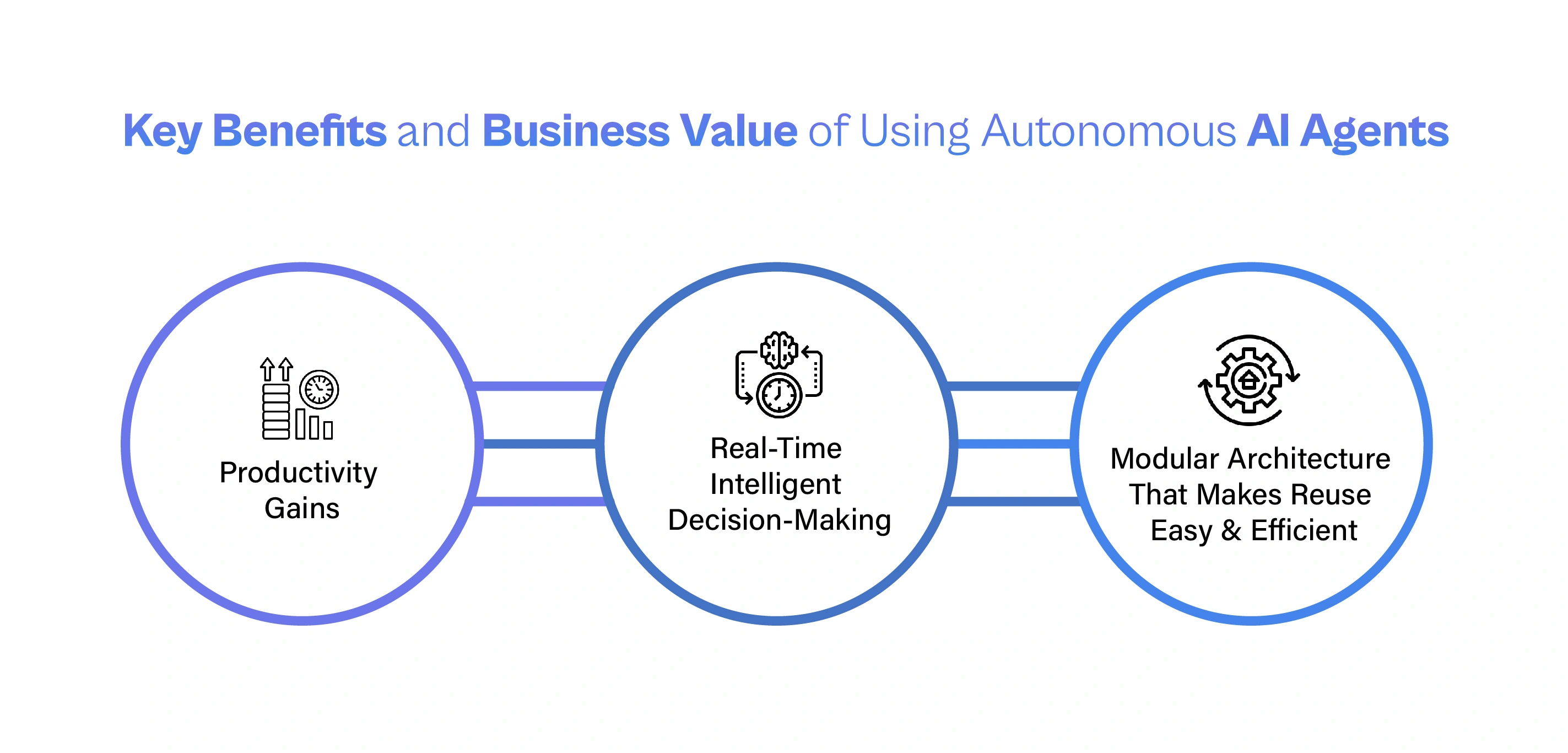
Productivity Gains
AI can handle monotonous jobs, freeing up employees' time for strategic or creative work. For instance, AI can already assist in creating responses or expediting ticket routing in customer care. This is a step towards real agentic AI, although it's not quite there yet. According to McKinsey & Company's 2023 prediction, AI may eventually add $2.6 to $4.4 trillion in value annually across several use cases examined in the study (some of which were unique to AI agents).
Real-Time Intelligent Decision-Making
Agents use up-to-date information from:
- Supplier networks
- TMS and ERP platforms
- Inventory systems
Instead of waiting for human assessment, they act quickly to eliminate exceptions and take opportunities.
Modular Architecture That Makes Reuse Easy and Efficient
Enterprise teams can develop modular, reusable reasoning blocks that support multiple agents, such as task planners or decision trees, rather than creating one-off agents. These composable, callable, and testable pieces function similarly to microservices. AI can be scaled across departments without creating task duplication for businesses. Reusable components reduce costs, accelerate development, and deliver predictable, high-quality performance.
How Enterprises Are Using AI Agents: High-Impact Use Cases
There are several possible uses for self-governing AI agents. To reach their maximum potential, however, agents work best when carefully coordinated and integrated. Before deploying AI agent systems, consider these best practices.
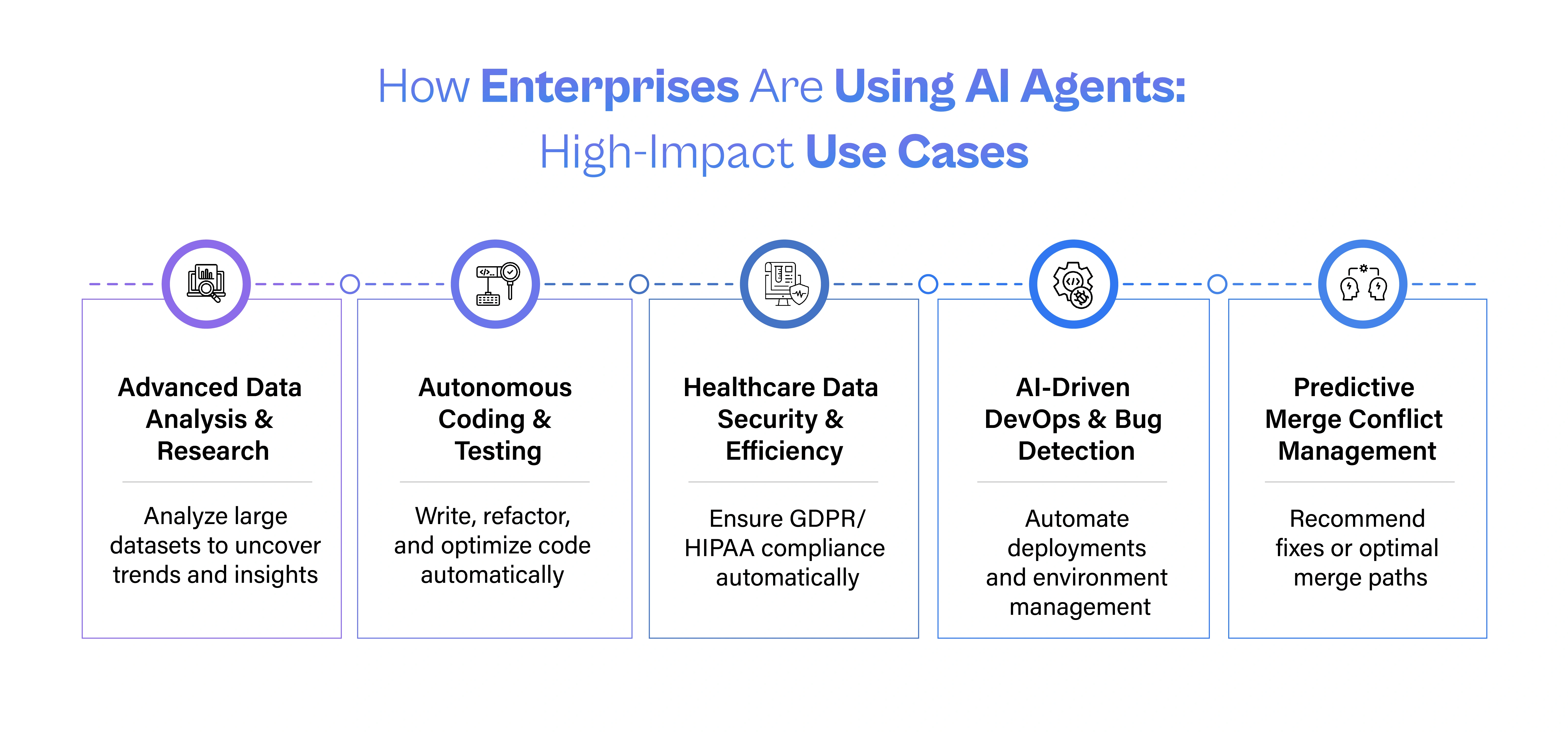
Next-Level Data Interpretation & Research Excellence
Autonomous AI agents have the potential to completely transform how businesses evaluate large datasets and conduct research. Improving searches rather than having human analysts manually query databases. An autonomous agent can be given a high-level research goal by synthesizing details. An agent might be used, for instance, by a pharmaceutical company to "identify new drug targets for Alzheimer's disorder."
The AI would thereafter independently do the following tasks:
- Access and analyze databases of scientific literature and clinical trial registries.
- Extract pertinent information and find trends. Cross-reference the results.
- Create theories regarding possible therapeutic targets or mechanisms.
- Provide a summary of the results and practical advice. Even make recommendations for future experimental validation procedures.
Such bots may be used, for instance, by a prestigious research institution to continuously monitor new scientific articles and identify breakthroughs or convergent research trends months before they are generally acknowledged. Accelerating discovery and ensuring that they are always working with the most current and relevant data, this gives researchers a significant competitive advantage.
Autonomous Coding Workflows with Cognitive Testing
Up to 70% of a developer's work can be spent writing and maintaining code. Coding assistants driven by Agentic AI make this process quicker and more intelligent. Based on project objectives, these agents can also suggest architectural enhancements in addition to creating new modules and refactoring existing code.
In addition to writing code, they also make sure that it is optimized across various frameworks, consistent, and compliant with best practices.
Example: In a JavaScript project, an autonomous agent can automatically submit optimized commits, identify ineffective loops, and recommend improved data structures.
One of the most time-consuming and repetitive phases of software development is testing. Self-learning testing agents that automatically generate, run, and refine test cases are introduced by Agentic AI. Without the need for developer oversight, these bots perform automatic QA around the clock, find edge cases, and discover regression issues. They may be directly integrated into CI/CD pipelines, ensuring real-time validation of each code modification, resulting in quicker releases with minimal errors.
Securing Patient Data & Reducing Physician Workloads
Because AI automates and monitors compliance with laws like GDPR and HIPAA, it is crucial for improving patient data security. These AI-powered systems ensure appropriate encryption, access control, and real-time data usage monitoring.
- Immediately detects unusual access patterns
- Seamlessly verifies compliance
- Proactively forecasts security risks
Autonomous AI DevOps & AI-Driven Bug Detection
By optimizing the deployment pipeline, agentic AI contributes significantly to DevSecOps automation. AI agents are capable of managing infrastructure scalability, executing zero-downtime rollouts, and keeping an eye on system health. Based on usage trends or performance standards, they can even determine when to initiate deployments. This leads to faster and reduced downtime, faster, more reliable deployments, and intelligent incident response when problems arise.
It frequently takes more time to find and repair bugs than to write the feature itself. Agentic AI assists by constantly reviewing logs, spotting irregularities, and anticipating any problems before they arise. These agents use automated debugging to identify the root cause of problems and provide specific solutions, which are sometimes implemented immediately. This minimizes post-release problems, improves system stability, and substantially reduces downtime.
Merge Conflict Prediction Early
Agents express purpose in addition to responding to contract modifications. A feature intent event with updated files and high-level objectives is published by the agent of a developer who develops a feature branch. To calculate a conflict risk score, other developer agents swiftly and locally simulate a merge. When danger is elevated, people either:
- Suggest merging an order or file ownership, or
- Minimal compatibility fixes should be automatically generated to minimize work.
Top Challenges in Autonomous AI Agent Development
Although autonomous AI agents have enormous potential, several important issues need to be resolved to ensure their efficacy, security, and moral use:
1. Hallucinations & Accuracy
Syntactically correct but factually incorrect outputs are frequently produced by generative models. Decision-makers may be misled by these "hallucinations." For example, when an LLM lacks expertise, it will confidently invent details. These mistakes have actual costs in business applications.
AI needs to be made more "reliable and predictable," analysts warn. According to a poll, only 17% of businesses thought their internal models were "excellent," while 61% of businesses had accuracy problems with their AI products. Even minor mistakes can violate rules or undermine confidence in high-stakes industries like healthcare, finance, and law.
2. Bias & Fairness
Data that reflects previous biases is used by AI machines to learn. If left unchecked, they may worsen or continue discrimination. For instance, if training data were skewed, an automated employment agent might favor particular groups. Businesses are concerned that a biased AI agent may result in legal liabilities. Over 60% of European respondents to a Deloitte survey expressed concern about the exploitation of personal data and the fairness of AI, and these dangers are particularly significant in regulated businesses. Strict data governance and bias prevention during development are necessary for ensuring fairness.
Moreover, AI agents are frequently "black boxes." According to McKinsey, AI still "lacks greater transparency and explanation," which is essential for enhancing security and reducing prejudice. Particularly in regulated environments, agents are difficult to debug or trust if they do not provide explicit reasons for their outputs.
3. Security Vulnerabilities
New attack surfaces may be introduced by agents. Microsoft researchers find new risks like prompt injection and memory poisoning, according to Dark Reading. An AI email helper was "poisoned" in a proof-of-concept using a carefully written email. After integrating the malicious instruction into its internal memory, the agent started sending private messages to an attacker.
In reality, any AI agent that has the capacity to store or retrieve data needs to be strengthened against these kinds of assaults. According to reports, defective agents may operate as "malicious insiders," disclosing information or acting destructively while under the sway of adversaries. To identify these hidden failure modes, security teams now advise ongoing observation and red-team assessment of agent behavior.
AI Agents in Action: Real-World Pilots & Enterprise Use Cases
Microsoft’s Latest Copilot Studio Enhancements
The development and application of AI agents is being revolutionised by Microsoft's Copilot Studio. Here are several ways that the most recent improvements enable businesses to create next-generation AI agents, from multi-modal interactions to autonomous operations.
1. AI Knowledge-Driven Agents for Smarter Decision-Making
Improve Agent Intelligence via RAG Improvements and Advanced Tuning
- What’s New: Utilize the most recent generative models, enhanced Retrieval Augmented Generation (RAG), and knowledge source analytics.
- Key Features: Utilize Azure AI Search indexes to access personalized knowledge bases, curate information, and improve responses.
- Best For: In customer service, support, or research positions, AI bots are answering complicated queries.
2. Intelligent Autonomous Agents for Workflow Automation
Develop AI That Suits You Without Any Prompts
- What’s New: Create agents that can finish tasks on their own without human assistance.
- Key Features: In Copilot Studio, you may modify pre built models or create agents from scratch.
- Best For: Saving time, increasing productivity, and automating repetitive processes.
3. Multi-Modal Autonomous Agents with Deep Context Awareness
Extend AI's Potential Beyond Text-Based Communications.
- What’s New: Provide agents the ability to interpret voice instructions and examine submitted images.
- Key Features: Incorporate generative AI with voice and visual input support into interactive apps and IVR systems.
- Best For: AI agents have voice capabilities for image-based data searches, interactive user experiences, and customer service.
Hugging Face Transformers: The Industry Standard for NLP Models
An open-source library called Transformers by Hugging Face offers a single interface to advanced pretrained models for computer vision, natural language processing (NLP), and other applications. It acts as the foundation for numerous copilots, AI agents, and unique LLM-based applications.
The Transformers Library Provides:
- More than 100,000 models for multimodal, text, vision, and audio tasks.
- BERT, GPT-2/3/4, LLaMA, T5, Falcon, Mistral, and numerous others are supported.
- Easy access to Hugging Face Hub for loading models in a single batch.
These models can be modified for tasks like reasoning, translation, summarization, and Q&A.
Highly Extensible
- Connects to TensorFlow, JAX, and PyTorch,
- optimized for fast inference, TorchScript, and ONNX.
- Suitable with accelerators, tokenizers, and datasets.
Use Cases
- Sentiment analysis, summarization, and classification of texts at an organizational level
- LLM agents in the financial, medical, and legal fields
- Prototyping research and investigating open-source AI
- Providing energy for virtual assistants and chatbots
What Enterprises Are Missing in the AI Agent Revolution
Just about 18% of respondents said they are not currently using AI agents, despite 88% planning budget increases for Agentic AI. By 2027, more than 40% of agentic-AI initiatives are expected to be shelved due to concerns about governance, integration challenges, or questionable value.
1. Trust & Maturity
- When it comes to financial or employee-facing autonomy, only one in five executives has faith in agents.
- 57% of business units in organizations with high AI maturity trust and employ AI, compared to 14% in those with low maturity.
- Executives have told me time and time again that they want control and oversight over agents. CIOs desire rollback, audit logs, traceability, and human-in-loop fail-safes.
- Instead of being an afterthought, governance is now a need for deployment.
2. Integration & Governance Bottlenecks
There is a growing gap in integration. Although most agent frameworks link with less than 20 applications out of the box, enterprises frequently run hundreds of interconnected systems.
There is still a lot of engineering work involved in connecting to CRMs, ERPs, and custom APIs. This complication has increased the possibility of "agent washing." Many projects that go by the name "agents" are just chatbots with additional connectors.
Conclusion
Autonomous AI agents are reshaping industries with their speed, adaptability, and ability to make complex decisions. Yet with this power comes a new set of challenges. Issues such as bias, data privacy, accountability, security threats, and job displacement underscore that the risks associated with autonomous AI cannot be overlooked. As these systems become more capable, the need for responsible oversight becomes even more urgent.
For organizations and policymakers, the path forward requires balance, leveraging efficiency while maintaining strong ethical safeguards, embracing autonomy while ensuring human oversight, and encouraging innovation while supporting thoughtful regulation. By embedding transparency, accountability, and fairness into every stage of an AI agent’s lifecycle, we can guide this technology toward positive impact.
With the right guardrails, autonomous AI agents can enhance human potential, strengthen decision-making, and drive meaningful progress, while minimizing the harm that unchecked automation can create.
Bring Autonomous AI Into Your Enterprise Stack
AI agents are redefining how modern software gets built. Don’t wait until your competitors get ahead.
Talk to our specialists and discover where autonomous workflows fit into your roadmap.

